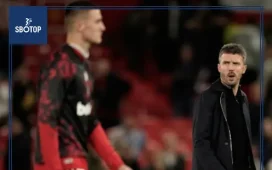



Derek McInnes celebrated his first Old Firm victory as Rangers manager in emphatic fashion as his side swept aside Celtic 3-0 at Ibrox to reach the semi-finals of the Premier Sports Cup.
Dan Neil scored twice and Kevin Kelsy added another goal on his Old Firm debut as Rangers delivered one of their most impressive performances of the campaign.
The result was not simply about the scoreline. Rangers controlled the contest for long stretches, disrupted Celtic’s build-up with an aggressive press and repeatedly forced the visitors into uncomfortable situations.
For McInnes, the performance provided an important early reference point for his tenure.
The Rangers manager had spoken about the need for his team to demonstrate greater consistency and intensity. Against Celtic, his players produced those qualities from the opening whistle.
The atmosphere at Ibrox was electric, with no away supporters permitted inside the stadium. Every successful challenge, interception and attacking move was greeted enthusiastically by the home crowd.
By full-time, the supporters had witnessed a memorable derby victory and a place in the last four of the competition.
A High-Intensity Opening
Rangers started the match with a clear intention to play on the front foot. Rather than allowing Celtic to establish possession, Derek McInnes instructed his players to press aggressively and engage their opponents high up the pitch.
The approach immediately created problems.
Kevin Kelsy had an early opportunity after Celtic goalkeeper Benjamin Johnstone attempted to clear the ball but sent it directly towards the Rangers forward.
With Johnstone away from his line, Kelsy tried to find the target but dragged his effort wide.
It was a warning for Celtic.
Another chance arrived shortly afterwards when Johnstone was again unable to fully clear his lines. The ball reached Minsu Kim, who struck towards goal.
Celtic defender Liam Scales reacted quickly to clear the attempt off the line.
Rangers were already establishing a pattern.
They were forcing mistakes and creating opportunities before Celtic had time to settle.
Dan Neil Breaks the Deadlock
The pressure eventually produced the opening goal in the 23rd minute. The move began with Rangers combining effectively in the final third.
Kelsy helped create the opportunity before finding Dan Neil on the edge of the penalty area.
The Rangers captain took his time and placed a precise finish into the bottom corner.
The strike was Neil’s first goal for the club and arrived at a significant moment.
Rangers had been threatening since the opening whistle, and the goal provided confirmation that their approach was working.
Ibrox erupted.
The home supporters had seen their team begin aggressively, and now they had the reward.
Celtic needed to respond, but Rangers did not allow the visitors to regain control.
Instead, the home side continued pressing and competing for every loose ball.
McInnes’ Tactical Plan Causes Problems
One of the defining features of Rangers’ performance was the tactical positioning of James Penrice.
The left-back operated as an auxiliary midfielder at times, helping Rangers create numerical strength in central areas.
That allowed the home side to press Celtic man-for-man.
Djeidi Gassama and Minsu Kim provided width and energy, while Dujon Sterling, Emmanuel Fernandez and Olwethu Makhanya were prepared to defend Celtic’s attacking players.
The structure gave Rangers a balance between aggression and security.
They could commit players forward without completely abandoning their defensive responsibilities.
Celtic found it difficult to play through the pressure.
Callum McGregor, normally one of the team’s most influential players in possession, struggled to find enough space to dictate the match.
Rangers repeatedly closed down passing options and forced Celtic into hurried decisions.
The result was a first half in which the visitors failed to create a clear-cut opportunity of their own.
Celtic Unable to Match Rangers’ Intensity
Celtic entered the quarter-final with an impressive domestic record.
The Hoops had won their opening six Premiership matches and arrived at Ibrox unbeaten in seven domestic games.
Yet that confidence did not translate into control.
Rangers were sharper in the challenges and more aggressive when possession changed hands.
Every time Celtic attempted to build from defence, Rangers looked to close them down.
The home side’s intensity also meant Celtic were unable to sustain attacks.
Even when the visitors managed to escape the initial press, Rangers’ defensive players were ready to compete for the next ball.
That collective effort was one of the clearest differences between the two teams.
Rangers looked connected.
Celtic struggled to establish the same rhythm.
Rangers Continue to Create Chances
The opening goal did not cause Rangers to become passive.
They continued looking for opportunities before half-time.
Celtic goalkeeper Johnstone was forced to remain alert, while Rangers repeatedly threatened through the wide areas.
The home side’s attacking movement was particularly effective.
Kelsy and Ryan Naderi provided a mobile front pairing, while Gassama and Kim offered width.
That created uncertainty for Celtic’s defenders.
The visitors were forced to make decisions about whether to step forward or protect the space behind them.
Rangers repeatedly benefited from those moments of hesitation.
By half-time, the 1-0 scoreline arguably flattered Celtic given the pressure they had faced.
Johnstone Keeps Celtic Within Reach
Celtic goalkeeper Johnstone played an important role in preventing the deficit from becoming larger before the break.
Early in the second half, he made a strong save to deny Kim.
Moments later, Naderi produced a close-range header that Johnstone also stopped.
Those interventions gave Celtic hope.
At 1-0, the match remained recoverable.
One goal could have completely changed the momentum.
But Rangers continued attacking.
They were not satisfied with protecting their narrow lead.
McInnes’ side continued to apply pressure, knowing that a second goal would place Celtic under enormous strain.
Kelsy Doubles Rangers’ Advantage
The breakthrough arrived in the 59th minute.
Kelsy made up for his earlier miss by scoring his first goal for Rangers.
The Venezuelan forward met a cross from Penrice and produced a powerful volley at the back post.
The finish sparked another huge celebration inside Ibrox.
For Kelsy, it was a particularly memorable moment.
He had joined Rangers with expectations surrounding his ability to contribute goals, and his first strike came in one of the biggest matches available to him.
The goal also changed the nature of the contest.
Celtic now needed two goals simply to force the match into a different situation.
Rangers, meanwhile, had more space to exploit as their opponents were forced to take greater risks.
Celtic Cannot Find a Way Back
Martin O’Neill attempted to change the flow of the match through substitutions, but Rangers remained in control.
The home side continued to press and attack.
At one point, Rangers thought they had scored a third goal through a set-piece situation, only for the effort to be ruled out for offside.
That decision did not discourage the hosts.
They kept searching for another opening.
Celtic occasionally managed to move forward, but their attacks lacked the speed and precision needed to seriously threaten Rangers.
The home defence remained organised.
The midfield continued competing.
And the attacking players kept forcing Celtic backwards.
The longer the match continued, the more difficult the visitors’ task became.
Neil Completes a Stunning Double
The third goal finally arrived in the 76th minute.
Neil received the ball outside the penalty area and produced another superb finish.
This time, his curling effort flew into the top corner.
It was a spectacular way to complete his personal double.
Neil had already made history by scoring his first Rangers goal earlier in the match.
Now he had two.
The captain’s performance was a fitting symbol of Rangers’ overall display.
He contributed defensively, helped control midfield and produced decisive moments in the final third.
The second goal effectively ended the contest.
Rangers had a three-goal advantage and Celtic had shown little indication that they could recover.
McInnes Praises a Complete Team Effort
After the final whistle, McInnes was understandably delighted.
The Rangers manager praised the contribution of his players and supporters, insisting that everyone had played their part.
He said the match demanded the team’s full attention and that Rangers had approached it with the necessary intensity from the beginning.
McInnes also highlighted the importance of finding the correct balance.
His team had to press Celtic, but they also needed to maintain defensive organisation.
They had to attack, but they could not leave unnecessary gaps.
Against Celtic, Rangers achieved that balance effectively.
The manager described the performance as a useful reference for the team going forward.
That may prove to be one of the most important consequences of the victory.
“Good Goals at Good Times”
Another key part of McInnes’ assessment was Rangers’ ability to capitalise on their opportunities.
The manager acknowledged that Rangers had not always made enough of their positive moments earlier in the season.
Against Celtic, that changed.
Neil’s opening goal arrived after 23 minutes.
Kelsy’s strike came shortly after the hour mark.
Neil’s second goal arrived with 15 minutes remaining.
Each goal arrived at a moment when it could strengthen Rangers’ control.
The first established the advantage.
The second created breathing space.
The third ended any realistic prospect of a Celtic comeback.
For McInnes, the timing was just as important as the finishing itself.
Dan Neil Emerges as the Derby Hero
Neil’s performance will remain one of the major talking points from the match.
The Rangers captain scored the first brace of his career and did so in an Old Firm quarter-final.
His first goal demonstrated composure.
His second showcased his technical quality.
Together, they gave Rangers the platform for a memorable victory.
Neil also played a central role in the team’s pressing structure.
He competed for loose balls and helped Rangers maintain their grip on the midfield.
The midfielder later described the experience as an unbelievable feeling, explaining that he could hardly have chosen a better occasion for the first double of his career.
His contribution was therefore significant both individually and collectively.
Kelsy Makes His Mark
Kelsy’s performance was another major positive for Rangers.
The forward missed an early chance but did not allow that mistake to affect him.
Instead, he remained involved and eventually scored the second goal.
That response demonstrated confidence.
For a player making his Old Firm debut, the pressure can be enormous.
Kelsy embraced the occasion.
His movement caused problems for Celtic’s defence, and his goal rewarded his persistence.
The strike should also provide confidence as he continues adapting to Scottish football.
Rangers’ Defensive Work Deserves Recognition
The 3-0 scoreline naturally focuses attention on Rangers’ attacking performance.
However, their defensive work was equally important.
Celtic entered the match with several dangerous attacking options, but Rangers largely prevented them from creating meaningful chances.
The home side defended high at times and protected the space behind the press when necessary.
Their three-man defensive structure allowed the wing-backs to push forward without leaving the centre completely exposed.
That organisation helped Rangers maintain control.
A clean sheet against Celtic also provides McInnes with evidence that his tactical approach can work at both ends of the pitch.
The Atmosphere at Ibrox
The absence of Celtic supporters created a different atmosphere from a traditional Old Firm fixture.
Only Rangers fans were present, meaning the stadium was heavily tilted towards the home side.
The supporters responded to the players’ intensity from the opening minute.
The early chances produced excitement.
Neil’s goal created an enormous reaction.
Kelsy’s strike generated another surge of noise.
By the time Neil scored his second, Ibrox was celebrating a victory that had already become one of the defining moments of McInnes’ early tenure.
The connection between the team and supporters was evident throughout.
McInnes recognised that relationship afterwards, emphasising that everyone had contributed to the outcome.
Celtic Captain McGregor Offers a Frank Assessment
Celtic captain Callum McGregor was unusually critical of his team’s performance after the match.
He said Rangers had looked like a team while Celtic appeared to be a collection of individuals.
His comments highlighted the tactical and psychological contrast between the two sides.
Rangers moved together when pressing.
Celtic struggled to do the same when possession was lost.
McGregor’s assessment also acknowledged one of the most important demands of playing at Ibrox.
Players must work for each other without the ball.
That collective effort was a major reason Rangers were able to dominate the contest.
Also Read: