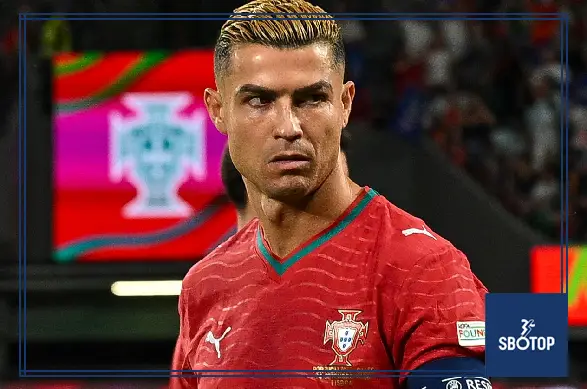
Cristiano Ronaldo has been provisionally suspended by the Portuguese Football Federation following his departure from the national team’s training camp after a disagreement with head coach Jorge Jesus.
The federation opened disciplinary proceedings against the forward, moving the controversy beyond competing public accounts and into a formal investigation. Ronaldo’s departure, his explanation and the circumstances surrounding it will now be considered through the disciplinary process.
The immediate distinction is important: a provisional suspension is not a final punishment. It establishes Ronaldo’s temporary status while the matter is examined, without confirming the eventual sanction or resolving every disputed detail.
The development also does not amount to an announcement of international retirement. Ronaldo has indicated that he remains willing to represent Portugal, although his availability and any future selection depend on separate decisions that have not yet been settled.
The Federation Opens an Urgent Case
The federation’s reported statement said proceedings were initiated through a decision dated October 9, 2026, concerning facts reported on October 7. It also explained that a non-automatic preventive suspension had been imposed following the period of automatic preventive suspension already applicable. The case was classified as urgent and referred to the disciplinary investigation committee on October 10.
Public disclosure was restricted until the investigation’s conclusion. That limits what can responsibly be said about evidence submitted, private testimony or the committee’s developing assessment.
The confirmed information establishes a process and a temporary measure. It does not provide a complete account of the investigation or establish that the disciplinary body has reached its final conclusion.
Urgent status indicates how the case has been classified. It should not be converted into a guaranteed date for resolution or an assumption about the severity of the eventual outcome.
The Disagreement Began Around Ronaldo’s Role
The dispute followed Ronaldo’s involvement in Portugal’s Nations League programme. He was an unused substitute during the team’s 2–1 victory away to Norway on September 27.
He subsequently left the squad’s base in Copenhagen before the match against Denmark. The departure followed disagreement about his role and his understanding of arrangements made with Jesus and the coaching staff.
Those events provide the basic chronology. The explanations surrounding them require more careful attribution.
Ronaldo’s account describes expectations that he believes were not fulfilled. That is relevant to understanding why he acted, but it does not independently prove the content of every private conversation.
Similarly, the fact that he did not appear against Norway cannot establish the coach’s motives. Selection and substitution decisions may involve several considerations, and their complete reasoning should not be invented to make the story more dramatic.
Ronaldo Presents His Version of Events
In his public explanation, Ronaldo said he understood that he would receive approximately thirty minutes against Norway. He warmed up but was not introduced.
He also described a further disagreement concerning how the situation would be explained publicly. His account framed the issue as a breakdown of trust rather than simply dissatisfaction with being left out.
These claims should remain clearly attributed to Ronaldo. The strength of his language does not remove the need to distinguish his recollection from an independently established agreement.
His statement is important because it records his explanation of the departure. It is not, by itself, the investigation’s conclusion.
The disciplinary process may consider relevant communications and circumstances, but the available public information does not reveal how those matters will ultimately be assessed. A responsible account can explain his position without endorsing every contested detail as fact.
Jesus Has a Different Account
Jesus denied that he had made the agreement described by Ronaldo. That difference leaves a central part of the controversy unresolved: what each party understood and what had actually been communicated.
The coach also left open the possibility of Ronaldo returning to the national team. His position therefore should not be simplified into a permanent exclusion.
A disagreement between player and manager can involve both immediate football decisions and wider questions of trust. However, public disagreement does not establish everything about their private relationship.
There is no basis for inventing dressing-room confrontations, attributing reactions to unnamed teammates or declaring that communication has become impossible.
The clearest interpretation is that the two parties have offered differing accounts while leaving a potential future relationship open. Whether that possibility becomes practical will depend on developments beyond the statements already made.
An Apology Does Not Resolve the Case
Ronaldo apologised for failing to acknowledge supporters after the Norway match and for leaving his teammates. He also accepted that his actions could have consequences and said he would remain available after serving any punishment.
That response adds an important element to the story. He has explained his grievances while also acknowledging responsibility for his conduct.
Nevertheless, an apology does not automatically determine the disciplinary outcome. The authorised body must assess the matter according to its own process.
Nor can it be assumed that every supporter or teammate has interpreted the apology identically. Collective reactions should not be invented from the existence of a public statement.
The apology establishes Ronaldo’s expressed position after the incident. Its significance within the case, including whether it affects any final sanction, remains a matter for the disciplinary authorities rather than outside prediction.
Federation Support and Disciplinary Independence
Federation president Pedro Proença has expressed a desire for Ronaldo to return once the matter is resolved. He has also emphasised that the disciplinary committee operates autonomously.
Those positions can coexist. A federation may wish to preserve a sporting relationship while allowing its disciplinary body to examine conduct independently.
The distinction prevents institutional support from being mistaken for an instruction about the result. Wanting the captain back does not establish that the investigation will end without punishment.
Equally, opening proceedings does not mean the federation has abandoned every possibility of reconciliation. Sporting objectives and disciplinary responsibilities address different questions.
The practical significance is that a return cannot be secured merely through a supportive statement. It must be compatible with the player’s status, the outcome of the process and the decisions of those responsible for selection.
Possible Punishment Must Remain Separate from the Temporary Measure
Discussion of potential sanctions has generated attention, particularly reports referring to a possible suspension lasting several months.
However, a range contained in disciplinary rules is not the same as a punishment already imposed. Its application would depend on the conduct established and the relevant assessment.
The provisional suspension should therefore be described precisely. It is a current measure within an ongoing process, not confirmation that Ronaldo has received the maximum possible ban.
Predictions of a particular number of missed matches are also uncertain without a confirmed final duration and clarity about its application.
The same restraint applies to claims that the case will necessarily conclude before a particular international window. Supporters may understandably seek a timetable, but an expectation is not a decision. The next authoritative development must come from the disciplinary process.
Captaincy Adds Context Without Settling Responsibility
Ronaldo’s role as Portugal captain gives the incident additional significance. A captain is closely associated with leadership, communication and the public identity of a team.
From an analytical perspective, leaving a camp can therefore raise questions beyond the availability of one forward. It can affect how responsibilities and expectations are understood within the group.
That does not justify treating leadership status as proof of every alleged breach. Responsibility still needs to be assessed through the relevant facts.
Nor should a single controversy erase the distinction between past achievements and present conduct. A player’s contribution to his country provides historical context, while the current case concerns specific actions.
The fairest evaluation recognises both. Reputation cannot decide the investigation, and the investigation should not become an excuse to invent conclusions about every stage of Ronaldo’s career.
Portugal’s Football Work Continues
Portugal must continue preparing its team while the disciplinary matter remains unresolved. Coaches need to plan around confirmed availability rather than assumptions about when Ronaldo might return.
That requires clear communication and practical selection decisions. The team cannot depend on a future resolution whose details are still unknown.
However, it would be speculative to prescribe a particular formation or identify a guaranteed replacement without confirmed information from the coaching staff.
The broader sporting principle is straightforward: a squad needs workable plans for the players available to it. Those plans can be revised when circumstances change.
Continuing that work does not make the controversy irrelevant. It reflects the fact that competitive responsibilities and disciplinary procedures operate on different timelines. Portugal must manage both, with neither process allowed to substitute for the other.
Willingness to Return Is Not a Confirmed Comeback
Ronaldo’s stated willingness to continue representing Portugal leaves the possibility of a return open. It does not establish that a recall has been arranged.
Several separate elements would need to align: his disciplinary eligibility, physical readiness, the coach’s assessment and the team’s requirements.
A return would also involve a working relationship capable of supporting clear expectations. That is an analytical consideration, not evidence that private negotiations have already produced an agreement.
The opposite prediction is equally uncertain. There is no confirmed basis for declaring that the episode has ended his international career.
His future therefore remains unresolved rather than predetermined. The public positions indicate that a return is possible, while the conditions and timing of any comeback still require decisions that have not been announced.
The Next Decision Will Define the Immediate Future
Ronaldo’s departure has now produced a formal disciplinary case and a provisional suspension. His explanation, Jesus’s differing account and the federation president’s supportive position form the public context around that process.
None of those statements alone determines the outcome. The investigation must establish what matters disciplinarily and what consequences, if any, should follow beyond the temporary measure.
For Ronaldo, the immediate issue is his status within the national team. For Portugal, it is how to maintain effective preparation while preserving clarity about responsibilities.
The next meaningful development will be a confirmed decision rather than another prediction about punishment or retirement.
Until then, the situation should remain accurately described: Ronaldo is provisionally suspended, the case is ongoing, and his longer-term relationship with Portugal remains open. The final assessment must follow the evidence and the authorised process.
Also Read: