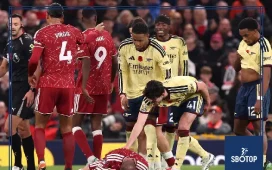
Everton secured their first away Premier League victory of the season with a 1-0 win over Newcastle United at St James’ Park on Monday, 2 November 2026. Thierno Barry scored shortly after half-time, while Newcastle’s disappointing evening ended with boos and a stoppage-time dismissal for substitute Jacob Ramsey.
The result rewarded Everton’s ability to create opportunities and protect a narrow advantage. Newcastle threatened an equaliser, particularly when Anthony Elanga struck the woodwork, but their attacking response lacked the consistency needed to overturn the deficit.
Ramsey’s red card added a damaging final incident rather than explaining the performance that preceded it. Newcastle had already spent much of the evening struggling to impose themselves. Everton, meanwhile, made the decisive moment count and completed a successful return to league action against opponents they had recently beaten in the League Cup.
Everton Create Openings Before the Breakthrough
The visitors had opportunities to establish a first-half lead. Barry failed to make meaningful contact with a promising chance, while Harrison Armstrong sent a close-range attempt off target shortly before the interval. Newcastle reached half-time level, but Everton had already shown that their attacking threat was substantial.
Those misses mattered because they delayed the reward for Everton’s work. Creating chances is encouraging, but an away team cannot assume the same opportunities will continue appearing after the break.
From an analytical perspective, the useful response is to preserve the movements that are working while improving the final action. Abandoning a productive approach because one attempt fails can make the next attack less effective.
Everton eventually found the required finish. Their persistence ensured that the first-half opportunities became part of a developing performance rather than the only moments on which their hopes depended.
Newcastle Reach the Interval without Finding a Rhythm
Newcastle’s difficulty was not simply that they had failed to score. Their possession did not consistently produce the penetration needed to unsettle Everton, leaving the visitors able to remain competitive without facing sustained pressure near their own goal.
In general, a team can move the ball without moving the opposition enough. Defenders become easier to manage when passes arrive predictably or attackers receive possession without supporting options.
That provides a framework for understanding the hosts’ problems. Effective progression requires coordinated movement, players willing to receive under pressure and decisions that exploit space before it closes.
However, those tactical observations should not be mistaken for proof that the players lacked effort or had rejected instructions. The evidence concerns the performance itself. Newcastle struggled to translate their work into clear attacking situations, and the score remained level despite Everton having produced dangerous openings.
Barry Punishes Newcastle after the Restart
Everton scored in the 49th minute after a quickly taken free-kick released Tyrique George. His shot escaped Lukas Horníček’s grasp, leaving Barry to convert from close range. The goal gave Everton the lead early in the second half and forced Newcastle to chase the game.
The sequence combined alert attacking play with a costly failure to secure the initial attempt. Barry’s contribution was to remain available when the loose ball appeared, ensuring the opportunity did not pass without a finish.
For Newcastle, the incident required more than a response from the goalkeeper. The speed of Everton’s restart also raised questions about defensive readiness and how quickly players recognised the danger.
Analytically, goals of this kind often emerge from several connected actions. The restart, the run, the shot and the rebound all mattered. Reducing the sequence to one mistake would overlook how Everton created and completed the opportunity.
The Goal Stands Despite Newcastle’s Objection
Newcastle manager Matthias Jaissle argued that contact between Barry and Fabian Schär in the build-up should have resulted in the goal being disallowed. The officials allowed it to stand, leaving the home side’s complaint as a disputed interpretation of the incident.
The subsequent Key Match Incidents Panel unanimously supported the decision to award the goal, judging that Barry had not committed a foul on Schär. It also unanimously supported the onside decision concerning the scorer.
Those findings provide important context without requiring speculation about the officials’ intentions or the players’ reactions.
A team can disagree strongly with a decision, but the disagreement does not itself establish an error. Equally, reporting the panel’s assessment does not erase Newcastle’s objection from the match narrative. The relevant distinction is between the complaint made afterwards and the later review supporting the outcome.
Elanga Comes Close to Restoring Equality
Newcastle’s clearest route back arrived when Elanga struck the post in the 66th minute. The ball travelled across the goal line without going in, and Everton escaped with their advantage intact. It was a significant opportunity to change the direction of the contest.
The incident demonstrates the limits of evaluating a match only through its final score. Newcastle did reach a position from which an equaliser was possible, even though their wider attacking performance remained disappointing.
However, hitting the woodwork does not establish that a goal was inevitable or that the home side deserved a different result. The attempt still had to cross the line.
For Everton, surviving that moment required an immediate reset. A narrow escape can become costly if defenders remain distracted by the previous action. Their task was to reorganise quickly and continue protecting the spaces Newcastle might attack next.
Pickford Contributes to Everton’s Clean Sheet
Jordan Pickford was called into action late on as Newcastle substitute Yoane Wissa threatened. His intervention helped preserve Everton’s lead during the period when the hosts were urgently searching for an equaliser. The visitors ultimately left with a clean sheet as well as the points.
Goalkeeping becomes particularly consequential when a match is separated by one goal. One successful save can preserve the value of the attacking breakthrough, while one error can undo the preceding defensive work.
Yet the clean sheet should not be attributed solely to Pickford. The players in front of him also had to contest deliveries, track movement and respond to second balls.
Everton’s success came from connecting those responsibilities. Their defence did not prevent every opportunity, but it limited the consequences when Newcastle did create one. That combination proved sufficient to make Barry’s finish decisive.
Ramsey’s Brief Booking Sequence Ends in Red
Ramsey received his first yellow card in the sixth minute of stoppage time and a second in the eighth, with the latter following a foul on Armstrong. His dismissal left Newcastle with ten players during the closing moments.
The chronology matters. Everton had led for most of the second half before the red card, so Newcastle’s defeat cannot reasonably be explained as the consequence of playing the match a player short.
Instead, the dismissal compounded an existing problem. The hosts needed to retain every available attacking option, but lost a substitute during their final attempt to recover.
From an analytical perspective, discipline is part of managing pressure. Frustration may explain the atmosphere surrounding a late challenge, but it does not establish a player’s intent or remove responsibility for the action. The confirmed outcome was two cautions and a dismissal at a particularly unhelpful moment.
Supporters Express Their Disappointment
Boos were heard at half-time and full-time as Newcastle supporters reacted to the performance. Jaissle acknowledged their frustration and accepted responsibility, also identifying insufficient bravery in possession and excessive reliance on long passes as concerns.
That response supplied a clearer explanation than speculation about unseen dressing-room disagreements. The manager publicly recognised problems in how the team had played.
Supporter disapproval, however, does not automatically confirm a decision about a coach’s future. Nor does it establish that every person in the ground shared the same assessment.
The footballing challenge remained concrete: make possession more purposeful, improve the connection between units and produce attacking situations more consistently. Newcastle needed those changes to appear during matches. Encouraging training sessions or explanations afterwards could provide context, but neither could replace the execution supporters expected to see on the pitch.
A Valuable Away Win with Work Still Ahead
Everton’s victory completed another successful meeting with Newcastle following their League Cup encounter. The club’s own report described Barry’s finish as his eighth goal of the season, adding another significant contribution to his campaign.
For David Moyes’ side, the broader value lay in turning an away performance into three points. They created opportunities, recovered from missed chances and maintained their advantage when Newcastle threatened.
The result did not guarantee that Everton’s away difficulties were permanently solved. It provided evidence of what could work, with the next challenge being to reproduce those qualities.
Newcastle faced the opposite task: address the weaknesses exposed without reducing the entire evening to the disputed goal or Ramsey’s dismissal. Barry supplied the finish, Everton protected it, and the hosts could not find an answer. The contrast between effective execution and unresolved frustration defined the night.
Also Read: