


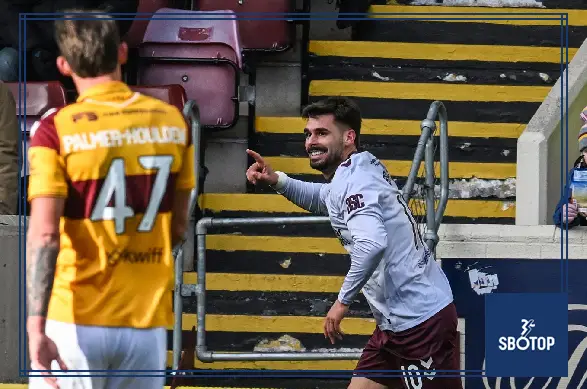
Hearts secured a valuable 2-0 victory at Motherwell on Sunday, 25 October 2026, combining decisive finishing with important defensive work to leave Fir Park with three Scottish Premiership points. Claudio Braga supplied the first-half breakthrough, and substitute Calvin Miller settled the contest with a late strike.
For Motherwell, the result brought a sixth consecutive league defeat. Their afternoon was not devoid of opportunities, but promising moments again failed to produce the goals needed to change their circumstances.
Hearts goalkeeper Beau Reus made several significant interventions, helping preserve an advantage that remained narrow until the closing stages. The visitors’ success therefore rested on more than the two finishes that defined the scoreline.
Played in difficult, windy conditions, the match demanded concentration and resilience. Hearts provided both when required, while Motherwell were left to confront the familiar frustration of contributing to a competitive game without taking anything from it.
Motherwell Threaten Before Hearts Find Their Rhythm
Motherwell had an early opportunity when Jordi Altena’s backpass created uncertainty for Reus. Seb Palmer-Houlden reacted and managed to get a shot away, but his effort found the side-netting.
The incident offered the hosts an opening before the visitors had settled. It also illustrated how quickly a seemingly routine defensive exchange could become dangerous in challenging conditions.
Motherwell continued to create encouraging situations. Emanuel Longelo advanced down the flank and tested Reus, while Jordan McGhee also forced the goalkeeper into action after arriving in a threatening position.
Those moments gave the home side reasons to believe they could end their disappointing sequence. However, an opportunity only influences the score when its final action is successful.
Hearts had to survive that initial examination. Their ability to remain level through Motherwell’s stronger moments provided the platform from which they eventually took the lead.
Braga Converts the Opportunity That Matters
Braga opened the scoring in the 29th minute, heading Saba Kerjota’s cross into the far corner. The move began with Stephen Kingsley lifting the ball forward, allowing Braga to help connect the attack before positioning himself to meet the return delivery.
The finish required judgement as well as technique. Braga had to assess the flight, separate himself sufficiently from the defence and direct his header beyond Alex Paulsen.
It was his fifth goal of the season and gave Hearts an advantage despite Motherwell having already created several chances.
That contrast became central to the afternoon. The hosts could point to promising attacking work, but Hearts had converted a crucial opportunity.
A goal does not automatically establish control, especially away from home. Nevertheless, it changes the demands of the match. Motherwell now needed to respond, while Hearts could consider how to protect their lead without surrendering all attacking ambition.
Reus Protects the Lead Before Half-Time
Motherwell attempted to answer Braga’s goal rather than allowing the setback to end their attacking effort. Dylan Levitt carried the ball into a shooting position and forced Reus into another save.
Palmer-Houlden also came close when he redirected a corner just over the crossbar. The chance reinforced the message that Hearts’ advantage remained vulnerable.
Reus’ contribution was particularly important because the visitors had little margin for error. With only one goal separating the teams, a successful Motherwell finish would have returned the contest to level terms.
Goalkeeping often becomes most visible when something goes wrong. On this occasion, several successful interventions helped determine how the match developed.
Hearts reached half-time ahead, but the score did not justify assuming the second half would be straightforward. Motherwell had shown enough attacking threat to ensure the visitors still faced substantial work.
Wind Adds Uncertainty to the Contest
Strong winds affected the afternoon at Fir Park, complicating deliveries, clearances and the judgement of high balls. Such conditions can make a familiar action less predictable, particularly when the ball holds up or changes its expected path.
That does not excuse every error. Both teams had to adapt, and the weather cannot explain the entire result.
However, it formed part of the practical challenge. Players needed to make repeated adjustments rather than rely entirely on their first reading of a pass or cross.
For defenders and goalkeepers, the consequences could be immediate. A ball that initially appears manageable can become a contested second ball near goal.
Hearts’ task was to preserve their organisation through those situations. Motherwell, meanwhile, needed to take advantage when uncertainty produced an opening. The match remained close partly because neither side could treat possession or territory as a guarantee of control.
Motherwell Continue Their Search After the Interval
The hosts maintained their effort during the second half. Joe Hodge sent a delivery across the face of goal without finding a teammate, while Longelo struck the outside of the post directly from a corner.
The latter incident demonstrated how conditions could turn a delivery into an unexpected threat. It also added to Motherwell’s growing collection of near misses.
Pressure has value only when it forces the opposition into increasingly difficult decisions or produces clear opportunities. Motherwell generated danger, but could not supply the decisive touch.
From an analytical perspective, this is an important distinction. A team can look active and committed while still falling short in the areas that determine the result.
Hearts did not eliminate every threat. Instead, they relied on a combination of defensive intervention, goalkeeping and Motherwell’s inability to finish. That kept the one-goal lead intact as the second half progressed.
Substitutions Give the Hosts Another Route
Motherwell introduced Eythor Bjorgolfsson and Jardell Kanga as they looked for a way to change the game. Bjorgolfsson provided an additional penalty-area presence and forced Reus into a reaction save with a header.
The opportunity was significant because it showed that the hosts could still reach dangerous positions against an organised defence. Their search for an equaliser was not confined to hopeful attempts from distance.
For Hearts, the arrival of different attacking players required fresh attention. Defenders had to adjust to new movement while maintaining awareness of the players already involved.
Successful defending in that situation is partly about communication. Responsibilities can become unclear when opponents change positions or introduce a different type of forward.
The visitors continued to resist. Reus’ save helped ensure that Motherwell’s adjustment did not immediately translate into the goal they needed to restore parity.
Miller Gives Hearts the Decisive Cushion
Miller, introduced from the bench during the second half, scored Hearts’ second in the 86th minute. Stephen O’Donnell’s clearance reached him outside the penalty area, and he drove a low shot into the bottom corner.
The timing transformed the closing stages. At 1-0, Motherwell had remained one successful attack away from rescuing a point. At 2-0, the hosts faced a much larger task with little time remaining.
It was Miller’s seventh goal of the season, adding another important contribution to his campaign.
The finish also illustrated the value of reacting to a clearance. A defensive intervention does not necessarily end an attack; the next player to collect the ball can create the decisive moment.
Miller recognised the opening and executed his shot. Hearts had finally established the cushion that their earlier lead had not provided, making their path to the final whistle considerably clearer.
Hearts Strengthen Their Position Without Overstating the Result
The victory kept Hearts third in the Premiership, four points behind second-placed Rangers and eight behind leaders Celtic immediately after the match.
It was also their first away league win outside Edinburgh since January, giving the result significance beyond the three points alone.
Those details describe the position following the Fir Park fixture. They should not be treated as a prediction of where Hearts would finish or a claim that every problem had been resolved.
The performance still contained difficult moments. Motherwell created opportunities, and Reus had important saves to make.
Nevertheless, winning away requires a team to handle the match it encounters, not simply the one it would prefer. Hearts did enough in both penalty areas to secure a clean sheet and a two-goal victory.
That combination provided a useful response during a demanding schedule involving domestic and European commitments.
Motherwell’s Losing Run Demands a Practical Response
A sixth consecutive Premiership defeat deepened Motherwell’s difficulties and left them 10th after the fixture. The sequence matched an unwanted run dating back to April 2003.
The frustration was understandable, but the performance still required a balanced assessment. Motherwell did create chances and forced the opposing goalkeeper into meaningful action.
That evidence prevents a simplistic conclusion that they offered nothing. Equally, it cannot remove the significance of another defeat without a goal.
Their challenge was to improve the connection between promising passages and decisive outcomes. Finishing mattered, but so did preventing opponents from converting a smaller number of opportunities.
Any claim that confidence alone explained the result would go beyond what could be established. The immediate football issues were more concrete: chances went unfinished, Braga’s header created the deficit, and Miller’s strike ended the prospect of a late recovery.
Two Finishes and a Goalkeeper Make the Difference
The defining moments at Fir Park belonged to Braga, Miller and Reus. Braga established the advantage, Reus protected it, and Miller supplied the late goal that settled the outcome.
Motherwell’s contribution made Hearts work, but it did not change the score. Their attacking effort brought opportunities rather than a breakthrough, leaving the losing sequence intact.
For Hearts, the afternoon demonstrated the value of being effective without controlling every phase. They survived the hosts’ pressure and converted the chances that mattered most.
The 2-0 result rewarded that combination. Hearts departed with a stronger league position and a notable away victory, while Motherwell faced the task of turning competitive moments into the points needed to halt their decline.
Also Read: