

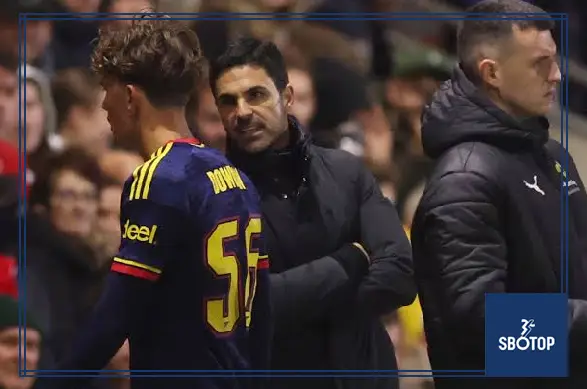
Arsenal’s attempt to overturn Max Dowman’s dismissal against Fleetwood Town has failed, leaving the teenager with a three-match domestic suspension following an already damaging League Cup exit.
The Football Association confirmed on 29 October that an independent Regulatory Commission had rejected claims of both wrongful dismissal and excessive punishment. The decision upheld the consequences of the red card shown during Arsenal’s fourth-round defeat two days earlier.
For Dowman, the outcome brought an immediate interruption to his first-team opportunities. For Arsenal, it added a selection problem to the disappointment of elimination. Beyond those practical consequences, the episode raised a familiar challenge in developing young footballers: helping an emerging talent handle difficult moments without allowing one incident to define his progress.
What Happened at Fleetwood
Dowman was sent off in the 85th minute after kicking out at Harrison Neal following a heavy challenge. His reaction was judged to constitute violent conduct, leaving Arsenal to finish the contest with ten players.
The match ended 1-1 before Fleetwood won the penalty shootout 5-3. The fourth-tier club therefore progressed at Arsenal’s expense, turning an uncomfortable evening for the visitors into a memorable cup success for the hosts.
The dismissal was a significant moment, but it should not become the sole explanation for Arsenal’s elimination. A match contains numerous decisions, chances and defensive situations. Assigning the entire outcome to one late incident would overlook the wider performance and Fleetwood’s achievement.
That distinction also matters when assessing Dowman. His actions carried consequences, while responsibility for the team’s overall result remained collective.
Arsenal Challenged Both the Decision and the Punishment
The appeal involved two separate arguments. Arsenal sought to challenge the dismissal itself and also contested the severity of the resulting punishment. Neither claim succeeded.
Those are distinct questions. A club can argue that a player should not have been dismissed, while separately maintaining that the normal suspension is excessive in the circumstances. The commission’s rejection of both claims meant Arsenal obtained neither the removal of the red card nor a reduction in the ban.
The outcome establishes the disciplinary position. It does not require every supporter or observer to reach the same personal interpretation of the footage.
Equally, disagreement with a decision should not be presented as evidence of an improper process. The confirmed development was that Arsenal used the available appeal route and the independent commission ruled against their case.
Three Domestic Fixtures Were Affected
When the appeal decision was announced, Dowman’s suspension covered Arsenal’s next three domestic matches, against Liverpool, Hull City and Newcastle United.
That made the consequences broader than the League Cup campaign in which the dismissal occurred. Arsenal’s elimination did not remove the suspension or confine its effect to a competition they had already left.
The practical cost was the loss of an available attacking option. It would nevertheless be speculative to claim that Dowman was certain to start any particular fixture. Availability and selection are different matters, especially for a teenager competing within an established first-team squad.
What can be said is that the ban removed the manager’s opportunity to consider him for those domestic games. It also denied Dowman the possibility of earning minutes during that period.
A Cup Upset With More Than One Turning Point
Fleetwood took the lead through Aaron Loupalo-Bi in the 21st minute before Viktor Gyokeres equalised in the 50th. Arsenal subsequently failed to secure a winner.
The shootout then produced the decisive separation. Fleetwood goalkeeper Jay Lynch saved Bruno Guimaraes’ penalty, and Conor Haughey converted the winning kick. Lynch had also made important late saves to keep the contest level.
Those details restore some balance to a story dominated by disciplinary debate. Fleetwood’s progression required more than benefiting from an opponent’s red card. They established a lead, survived Arsenal’s response and completed the shootout successfully.
For Arsenal, the wider lesson concerned converting opportunities and avoiding dependence on narrow margins. Dowman’s dismissal formed part of that evening, but the match had already presented numerous opportunities for a different outcome.
An Interrupted Opportunity for Dowman
The League Cup had provided Dowman with meaningful involvement. He started Arsenal’s two ties in the competition, scoring twice against Ipswich Town in the previous round before the Fleetwood dismissal.
His other first-team opportunities that season had included substitute appearances in the Premier League and Champions League. Against that background, a three-match domestic absence represented a potentially important interruption rather than simply a routine gap in an established starting schedule.
For a developing player, opportunities are not measured only by the number of matches missed. A place on the bench can lead to an unexpected appearance, while injuries or changes in a game can create openings that were not obvious beforehand.
The suspension closed off those possibilities temporarily. Its longer-term importance, however, would depend on how Dowman responded when eligible again.
Physical Pressure Is Part of the Development Challenge
Young attacking players moving into senior football encounter opponents who are stronger, more experienced and skilled at disrupting rhythm. Learning to operate within that environment is an important part of development.
That does not excuse dangerous challenges or place responsibility for every confrontation on the player receiving contact. Officials remain responsible for judging incidents and applying the rules.
For the attacker, though, the next response matters. A reaction made in frustration can create a separate disciplinary issue, even when it follows an uncomfortable challenge.
This is a general footballing lesson rather than a claim about Dowman’s private thoughts during the incident. His intentions should not be invented. The observable issue is that a moment following contact resulted in a dismissal, and the appeal did not reverse it.
Support and Accountability Need to Work Together
Arsenal’s challenge is to help Dowman learn while maintaining a proportionate response. At 16, he is still developing the emotional judgment required alongside technical ability.
Support does not require pretending that an upheld dismissal has no significance. Accountability does not require treating a teenager’s mistake as a permanent verdict on his temperament.
The most constructive approach would connect the incident to specific future decisions: how to disengage after contact, recover position and remain available to influence the game. Those are practical behaviours that can be developed.
There is no need to invent private disciplinary measures or dressing-room conversations to make that point. The public outcome already provides a clear lesson. A reaction on the pitch can affect both the current match and several fixtures afterwards.
Selection Consequences Require Careful Interpretation
Losing an attacking option can complicate a manager’s planning, but it does not automatically determine a formation or starting line-up. Other players, fitness assessments and tactical requirements all influence those choices.
It would therefore be misleading to announce a particular replacement solely because Dowman’s appeal failed. A possible opportunity for another youngster remains a possibility until the manager selects the team.
The same caution applies to predictions about results. Arsenal’s prospects in subsequent matches could not responsibly be reduced to whether one teenage player was available.
The confirmed consequence was narrower: the squad had one fewer eligible option for three domestic fixtures. Any wider effect needed to be assessed through the teams selected and the football that followed.
One Incident Should Not Become a Complete Career Assessment
High-profile young players often receive sweeping judgments after limited evidence. A strong performance can produce unrealistic expectations, while a dismissal can prompt equally exaggerated doubts.
Neither response offers a reliable assessment of development. Technical progress, decision-making and emotional control are built over time and observed across many different situations.
Dowman’s red card deserves scrutiny because it affected his availability and left Arsenal short-handed late in the tie. It does not, by itself, establish how he will respond to pressure throughout his career.
A more useful assessment would examine subsequent behaviour. Does he remain engaged after difficult challenges? Can he maintain concentration when space is restricted? Does frustration affect his next action?
Those questions allow room for accountability and improvement without turning a single episode into a fixed label.
The Next Response Matters Most
Arsenal’s unsuccessful appeal settled the immediate disciplinary dispute. The dismissal stood, the three-match domestic suspension remained in place, and attention had to move towards managing its consequences.
For the club, that meant adapting selection plans and addressing the broader shortcomings of the Fleetwood performance. For Dowman, it meant using an enforced interruption as part of his development rather than allowing disappointment to dominate the next stage.
Fleetwood’s achievement also deserved to remain central. They earned progression through their performance and successful penalties, regardless of the debate surrounding Arsenal’s teenager.
Dowman’s progress would ultimately be judged over a much longer period. The important next step was not another argument about the decision, but a measured return in which his football, composure and contribution could provide the response.
Also Read: