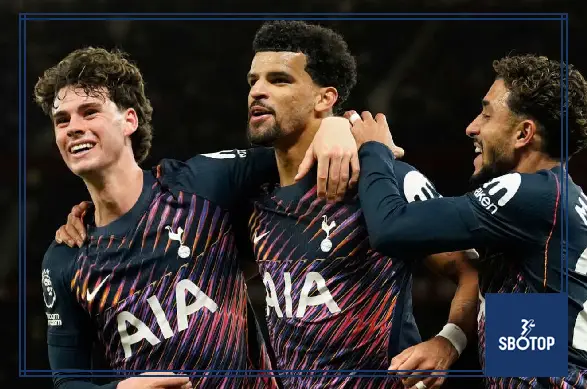
Dominic Solanke delivered a stoppage-time equaliser as ten-man Tottenham Hotspur recovered to draw 1-1 with Manchester United at Old Trafford on Saturday, 10 October 2026. His late header transformed the closing stages of a match that United appeared well placed to win after taking the lead and then gaining a numerical advantage.
Bryan Mbeumo had opened the scoring in the 73rd minute, finishing after an assist from Matheus Cunha. Tottenham’s situation deteriorated five minutes later when Rodrigo Bentancur received a straight red card for violent conduct. Yet the visitors kept searching for an opening, and Solanke met Sandro Tonali’s cross in the second minute of added time to secure a point.
The outcome carried different emotions for the two teams. Tottenham could appreciate their recovery without forgetting another match had passed without a league victory. United were left confronting the failure to protect a lead against opponents reduced to ten players.
It was a dramatic finish, but the equaliser was not the afternoon’s only significant story. Tottenham had created opportunities before falling behind, making their eventual reward a reflection of more than late desperation.
Tottenham Establish the Early Threat
Spurs were the more threatening side for substantial periods before Manchester United scored. Their attacking work created opportunities, but the finishing touch repeatedly failed to match the approach play.
That distinction shaped the match. Tottenham could move into useful positions and ask questions of United’s defence, yet they could not turn those moments into an advantage on the scoreboard.
For United, surviving that pressure kept the contest open. A team does not need to dominate every phase to win, but repeated defensive demands can make its position increasingly fragile.
From an analytical perspective, Tottenham’s problem was converting progress into end product. Reaching the penalty area is valuable only when the final pass, movement and finish connect.
Nevertheless, their attacking threat matters when assessing the result. The late equaliser should not make the preceding performance disappear. Spurs had been searching for a goal long before the dismissal increased the difficulty of their task.
A Goalless Interval Leaves the Contest Unresolved
The teams reached half-time at 0-0, leaving both with reasons to believe the match could still move in their favour. For Tottenham, the frustration lay in opportunities that had not produced a goal. For United, the interval offered a chance to improve their attacking influence while preserving the defensive work that had kept them level.
A scoreless half does not necessarily indicate balance in every aspect. One team can create the more dangerous situations while the other remains equally close to a breakthrough in numerical terms.
That was an important feature of this contest. United had not established a commanding position, but they had avoided conceding.
The coaches could therefore consider changes without needing to chase a deficit. However, their exact dressing-room instructions cannot be established simply by examining what happened after the restart.
What remained clear was that the match still required a decisive action. Neither side had yet combined its approach play with the execution needed to change the score.
Solanke’s Afternoon Demands Persistence
Before his equaliser, Solanke had experienced the frustration of opportunities that did not become goals. One second-half chance followed a low delivery from Savio, but the striker could not keep his effort down under pressure from Lisandro Martínez.
For a forward, such moments create a practical challenge. The next run still has to be made, and the next delivery still has to be attacked, regardless of what happened earlier.
That does not require assumptions about Solanke’s private thoughts. His eventual contribution can be assessed through what he continued to do on the pitch.
Strikers often operate in a role where a small number of touches decide how their performance is remembered. A match containing missed opportunities can change significantly through one successful finish.
Solanke’s afternoon eventually followed that pattern. The earlier chances remained part of the evaluation, but they did not prevent him from providing the action that secured Tottenham’s point.
Mbeumo Gives United a Crucial Breakthrough
Mbeumo’s goal offered United the decisive moment they had been seeking. Cunha supplied the assist, and the forward’s left-footed finish put the hosts ahead with 17 minutes of normal time remaining.
The breakthrough altered the demands of the contest. United no longer needed to search for an opening goal; they needed to manage an advantage. Tottenham, meanwhile, had to turn their attacking efforts into an equaliser before time ran out.
From an analytical standpoint, this is where possession and territory must serve the scoreline. A leading team can slow the match through secure passing, pursue a second goal selectively or defend in a more compact shape.
None of those approaches guarantees success. Their effectiveness depends on coordination and the quality of decisions within each phase.
For United, the goal created an opportunity rather than a completed job. The events that followed would make their position appear stronger, but they still needed to execute the final part of the match.
Bentancur’s Dismissal Raises the Stakes
Bentancur was sent off following a confrontation with Luke Shaw. The midfielder’s headbutt brought a straight red card, leaving Tottenham both a goal and a player down as the match approached its closing stages.
The dismissal was a disciplinary setback separate from Tottenham’s earlier failure to finish their chances. It made the pursuit of an equaliser more difficult and required the remaining players to cover additional responsibilities.
United, conversely, had a clear numerical advantage. That should have provided more options when keeping possession and defending against Tottenham’s attempts to attack.
However, an extra player does not end a contest. The leading side still has to identify where the spare man can help and avoid decisions that surrender control unnecessarily.
The incident also introduced an emotional challenge for both teams. The subsequent football still required clear judgment, but it would be speculative to assign a particular psychological reaction to every player involved.
The measurable consequence was straightforward: Tottenham had to complete their recovery with ten men.
An Extra Player Still Requires Effective Game Management
United’s failure to win will naturally direct attention towards their handling of the numerical advantage. The combination of a lead, home support and an extra player created a favourable position.
Yet those conditions still needed to become controlled passages of play. Keeping the ball, reducing avoidable turnovers and preventing uncontested deliveries were practical requirements.
A team can become vulnerable if it retreats without maintaining pressure on the ball. Equally, committing too many players forward can expose spaces that a smaller opposition force may still exploit.
The task is therefore one of balance. The extra player should help provide passing security and defensive cover, but only if the team’s positioning makes that advantage available.
United did not convert the situation into a second goal or a protected clean sheet. That outcome provides a clear starting point for evaluation.
It does not, by itself, establish that every decision after the red card was wrong. A useful review must identify the particular actions that allowed Tottenham to remain within reach.
Tonali Supplies the Delivery That Changes the Result
The equaliser depended on the relationship between Tonali’s delivery and Solanke’s movement. The midfielder sent the ball into the penalty area, and the striker found the space to direct his header beyond United’s goalkeeper.
Solanke got away from Martínez to meet the cross, providing the finish Tottenham had lacked earlier.
The move illustrated why numerical superiority must be expressed around the ball and inside the area. Having more players on the pitch does not prevent a goal if the opponent can still deliver accurately and find a runner.
For Tottenham, the quality of the cross was as important as the final contact. A forward’s movement needs a delivery that reaches the relevant space at the right moment.
The outcome was a collective attacking success with a clear individual finish. Tonali created the opportunity, and Solanke supplied the action that changed defeat into a draw.
United were left with little time to recover the advantage they had held.
A Late Goal Rewards Tottenham’s Continued Effort
Solanke’s equaliser was dramatic because of its timing and the circumstances surrounding it. Tottenham had been reduced to ten men and were trailing away from home, yet they preserved a route back into the contest.
That achievement supported a positive assessment of their response. It did not mean the red card had been beneficial, nor did it remove the need to address the incident.
The distinction matters. A team can recover impressively from a setback that it would still have been better to avoid.
Likewise, the equaliser did not erase Tottenham’s earlier missed opportunities. Those chances were part of the reason they needed a late rescue.
The most balanced reading therefore recognises both sides of their performance: enough attacking quality to create a competitive position, and insufficient efficiency to turn that quality into a more comfortable result.
The final header secured a point, while leaving several reasons to believe the afternoon might have produced something different.
De Zerbi Finds Encouragement in the Response
Roberto De Zerbi expressed satisfaction with Tottenham’s spirit and character after the match. His assessment focused on how the team continued competing despite falling behind and losing a player.
That was understandable given the sequence of events. Spurs had encountered two major setbacks in quick succession but still found an equaliser.
However, the coach’s positive interpretation should remain distinct from a prediction about future results. One recovery does not prove that a wider change in form has been completed.
Tottenham remained without a Premier League victory after six matches. The draw offered encouragement, but it did not resolve that central issue.
For De Zerbi, the opportunity is to turn the best aspects of the Old Trafford performance into something repeatable. Creating chances and responding to adversity are useful foundations, but they need to be accompanied by stronger finishing and discipline.
A point rescued late can provide evidence of progress without becoming proof that all the team’s problems have been solved.
Carrick Faces the Frustration of Two Points Lost
Michael Carrick’s reaction reflected United’s disappointment. He acknowledged dissatisfaction with the result and with the points collected during the opening part of the league campaign.
The circumstances made that frustration sharper. United had moved ahead and then watched Tottenham lose a midfielder, only to concede in stoppage time.
For the manager, the review has to cover more than the final cross. United also need to examine why Tottenham had been able to create so many opportunities before the breakthrough.
A narrow lead can conceal earlier weaknesses. If the opposition remains competitive throughout, one late attack can overturn the apparent direction of the result.
At the same time, Mbeumo’s finish showed that United could produce the quality required to take the lead. Their problem was connecting that contribution with a more complete team performance.
Carrick’s task is to improve both the control preceding the goal and the management that follows it, rather than treating the equaliser as an isolated misfortune.
The Result Leaves Both Teams Searching for More
The draw left United with six points from their opening six Premier League matches. Tottenham, meanwhile, remained winless and stood 18th after the match.
Those figures explain why the result could not be entirely satisfying for either club. Spurs had rescued something valuable, but both teams still needed victories to strengthen their positions.
An early-season table is a record of what has happened, not a guarantee of what follows. Nevertheless, the accumulated points create practical pressure because future results must compensate for opportunities already missed.
For United, a home match against ten opponents had become another draw. For Tottenham, an encouraging performance had still stopped short of a first league win.
The immediate priorities were therefore different but connected. United needed to turn advantages into victories, while Spurs needed to turn competitive attacking displays into a stronger return.
Neither challenge could be settled through the drama of one late goal alone.
Also Read: