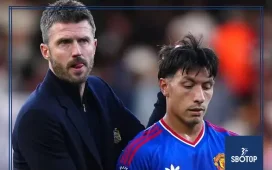


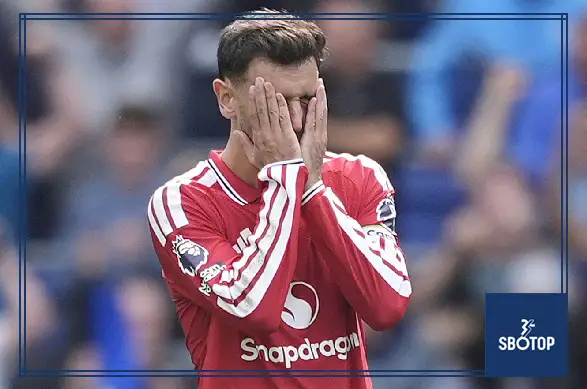
Bruno Fernandes has spent much of his Manchester United career supplying solutions. His passing, shooting and willingness to assume responsibility have repeatedly made him central to the team’s attacking identity. This season, however, his declining influence has become part of the problem Michael Carrick must address.
The debate has already moved beyond whether United’s captain could lose his place. Carrick left Fernandes on the bench against Bournemouth on October 25, describing the decision as football-based. United subsequently lost 3-0, and Fernandes remained unused.
That outcome settled little about the original selection dilemma. It demonstrated that removing the captain did not immediately repair the team, but it did not establish that his recent performances justified automatic selection.
Carrick’s challenge is to recover an influential player while building a side capable of functioning without depending on him to solve every difficult situation.
A Difficult Spell Against Exceptional Standards
Bruno Fernandes ’ recent performances attract attention partly because of the standards he has established.
He has been United’s principal creative reference for long periods, accepting responsibility for ambitious passes, set pieces and attempts from distance. When those actions succeed, they can transform an otherwise unconvincing performance.
When they fail, the weaknesses become more visible.
Ahead of the Bournemouth match, Fernandes had gone five Premier League appearances without scoring or assisting. That sequence supported concerns about his output, although goal contributions alone cannot explain the full quality of a midfielder’s performance.
An assist depends on a teammate completing the chance. A productive performance can therefore finish without a direct statistical reward.
Even with that qualification, United needed more consistent influence from their captain. His reputation reflected sustained achievement, but the immediate selection decision concerned what he could contribute in the next match.
The Wider Team Offers Little Protection
Fernandes’ difficulties have unfolded within a struggling collective. Manchester United poor results make it harder to isolate an individual decline from problems affecting the entire side. A creative player needs passing options, coordinated movement and enough stability behind him to attempt difficult actions.
If those conditions deteriorate, his choices become less attractive.
He may receive possession under greater pressure, find fewer forward runs or attempt ambitious passes because simpler combinations are not progressing the attack.
These are tactical possibilities rather than a confirmed explanation for every Fernandes performance. They nevertheless show why blaming one player would be inadequate.
The opposite argument is also incomplete. Collective weakness does not remove individual responsibility.
Fernandes still has to judge when to release the ball, when to retain it and how to respond after possession changes. United’s problems provide context for his form, but they cannot make every decision beyond criticism.
Creativity Comes With a Degree of Risk
Evaluating Fernandes requires recognising the nature of his role.
Players expected to create openings attempt passes that carry a greater chance of failure. A defence-splitting ball can produce an immediate opportunity, but it is inherently more difficult than a short pass to an unmarked teammate.
Raw passing accuracy therefore offers only a partial assessment.
The more useful distinction concerns the quality of the risk. An ambitious pass can be justified when the receiver is moving into space and the team is positioned to recover if it fails.
The same attempt becomes less useful when the target is isolated or the team is exposed.
For Carrick, improvement should involve creating conditions in which Fernandes’ imagination has a reasonable chance of succeeding.
Simply demanding fewer mistakes could reduce his attacking value. Accepting every turnover because he is creative would be equally unhelpful.
Workload Raises a Legitimate Consideration
Fernandes’ extensive involvement under Carrick has also contributed to discussion about his form.
Before the debate intensified in October, he had played almost all the available minutes during the coach’s tenure. Such reliance demonstrated his importance, but also raised a reasonable question about how effectively United were managing their most influential players.
A heavy workload can affect sharpness, recovery and decision-making. It cannot, without further evidence, be identified as the confirmed cause of Fernandes’ decline.
The distinction matters.
Observers can recognise that rest might help without diagnosing exhaustion from a poor performance. Likewise, playing regularly does not prove that a footballer is operating at full capacity.
Carrick and the medical staff have access to information unavailable publicly.
Their task is to distinguish a temporary loss of rhythm from a situation requiring reduced minutes, altered responsibilities or recovery time away from the starting lineup.
Fitness Concerns Require Evidence
United acknowledged a minor fitness concern before the Champions League trip to Atlético Madrid.
That information was relevant to assessing Fernandes’ condition, but it did not establish that injury explained his broader run of form.
There was no public basis for identifying a specific long-term physical limitation or predicting how much treatment or rest he required.
A player can be available for selection while experiencing discomfort. Equally, the existence of discomfort does not explain every misplaced pass or ineffective attacking action.
The responsible interpretation remains limited: fitness was a consideration, while its precise relationship to performance was uncertain.
For Carrick, that uncertainty reinforces the need for individual assessment.
Decisions about starting, substituting or resting Fernandes should follow the best available football and medical information. Public pressure alone provides neither a diagnosis nor a reliable recovery plan.
The Como Comments Complicate the Debate
Fernandes’ public assessment after United’s 4-1 Champions League defeat at Como added another dimension.
He questioned the decision to sit back rather than press more aggressively, bringing attention to the team’s tactical approach and the coaching staff’s instructions.
Those comments inevitably affected how his subsequent omission was interpreted.
However, Carrick stated that the Bournemouth selection was made for football reasons. There was no confirmed public explanation establishing that Fernandes had been dropped as a disciplinary punishment.
That distinction should remain clear.
It is possible to debate whether a captain should express tactical disagreement publicly without presenting speculation about internal consequences as fact.
The footballing issues also remained unresolved regardless of the interview. United still needed greater attacking coherence, Fernandes still needed improved performances and Carrick still had to select the combination most likely to deliver a result.
Dropping Him Requires a Credible Alternative
Leaving out a prominent player is meaningful only when connected to a workable team plan.
United must replace Fernandes’ functions, not merely remove his name from the lineup. Those functions include progressing attacks, supplying the final pass and offering a shooting threat.
Different selections can redistribute that work, but the responsibilities still need to be performed.
A more secure midfield might help United control matches while creating fewer immediate openings. An additional attacker might increase penetration but leave other areas vulnerable.
Those are trade-offs for the coach to assess.
The argument for resting Fernandes is strongest when it identifies how the alternative arrangement improves the team and creates a route back for him.
A change made simply to demonstrate authority risks becoming symbolic. A decision supported by clear tactical responsibilities can be useful even if its benefits take time to emerge.
Bournemouth Shows the Limits of One Change
The 3-0 defeat by Bournemouth prevented Carrick’s decision from producing the immediate response he wanted.
It did not prove that Fernandes would have changed the result. Claims about an unused player rescuing a match remain hypothetical.
Nor did it show that his previous form had suddenly become acceptable.
Instead, the match demonstrated the limits of treating one selection as the answer to wider problems.
United needed improvement in several connected areas, and the captain’s absence did not supply it automatically.
That leaves Carrick with a more demanding task than choosing between unconditional loyalty and permanent exclusion.
Fernandes can be important to the next solution without being exempt from selection standards. His replacement can offer something useful without being expected to resolve every weakness.
The relevant judgement concerns how the whole team performs, rather than whether one decision produces an immediate headline.
A Route Back Built on Clear Responsibilities
Fernandes’ best route towards improved form is likely to involve clarity.
He needs to understand where Carrick wants him receiving possession, which movements should develop around him and what the team expects when the ball is lost.
That does not require removing his freedom. It means giving his creative decisions a more dependable framework.
United would also benefit from distributing responsibility. Other players must advance attacks, create chances and provide leadership rather than waiting for the captain’s decisive intervention.
Fernandes remains capable of contributing substantially, but past achievement cannot replace current performance.
Carrick’s responsibility is to make selection responsive to form while preserving a realistic path to recovery.
The captain’s decline deserves scrutiny, and a spell outside the team can be justified. United’s larger challenge is to ensure that any change forms part of a coherent football plan, allowing their most influential creator to become effective again.
Also Read: