

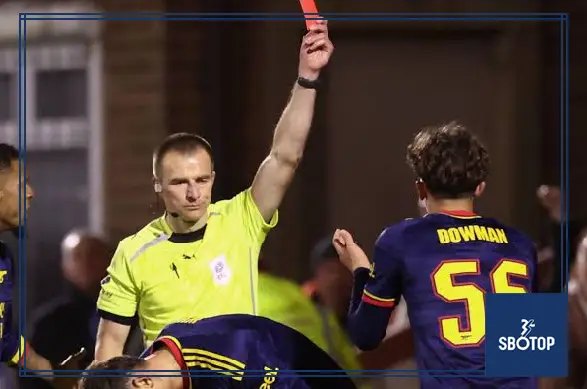
Dermot Gallagher predicted that Arsenal would fail to overturn Max Dowman’s red card at Fleetwood Town, identifying the teenager’s apparent retaliation as the decisive issue. The former Premier League referee’s assessment subsequently matched the disciplinary outcome: Arsenal’s challenges against both the dismissal and the punishment were rejected.
The sequence matters. Gallagher offered an opinion while the appeal was unresolved; an independent regulatory commission later delivered the official decision. His prediction was informed analysis, rather than advance confirmation of a verdict.
For Arsenal, the episode extended the consequences of an unexpected Carabao Cup exit. For Dowman, it created a difficult lesson about responding to physical challenges. For everyone assessing the incident, it raised a distinction that remained central throughout: an opponent’s challenge and the reaction to it must each be judged on their own merits.
Why Gallagher Expected Arsenal to Lose
Gallagher’s reasoning focused on what he considered an aggressive, deliberate movement by Dowman after Harrison Neal’s challenge. He interpreted the raised knee and kicking action as sufficient grounds to support the dismissal.
His assessment was direct, but it remained an interpretation of the footage. Other observers considered the punishment harsh, illustrating why the incident generated disagreement rather than immediate consensus.
Importantly, Gallagher did not defend everything surrounding the episode. He also believed Neal’s challenge should have resulted in a free-kick to Arsenal and a yellow card for the Fleetwood player.
That combination explains his position more accurately than describing him as simply taking the referee’s side. He identified a possible offence against Dowman while maintaining that the teenager’s subsequent reaction warranted separate punishment. In his reading, recognising the first problem did not remove the second.
The Incident Behind the Appeal
Dowman was dismissed late in Arsenal’s fourth-round tie at Highbury Stadium on October 27. The 16-year-old reacted after a heavy challenge from Neal, and referee Michael Salisbury showed a straight red card for violent conduct.
Arsenal were drawing 1-1 and finished the contest with ten players. Fleetwood subsequently won the penalty shootout 5-3, eliminating the Premier League champions.
The dismissal therefore carried two immediate consequences. Arsenal lost a player during the closing stages of a competitive match, and Dowman faced disciplinary action beyond the evening itself.
Those consequences should remain distinct from a complete explanation of the result. A late red card complicated Arsenal’s task, but it did not account for everything that had happened beforehand. Fleetwood’s performance and Arsenal’s inability to establish a winning margin were also part of the contest. The disciplinary debate should not erase that wider context.
Why Winning the Ball Is Not Conclusive
One feature of Gallagher’s analysis concerned the original challenge. His view was that Neal’s contact with the ball did not automatically make the tackle acceptable.
That principle is consistent with the distinction drawn in football’s laws between careless, reckless and excessively forceful challenges. A reckless action disregards the danger or consequences for an opponent and requires a caution. A challenge involving excessive force or endangering an opponent’s safety requires dismissal.
The important point is that touching the ball does not settle every question about a tackle. Officials must assess the action as a whole, including its danger and consequences.
This does not mean Gallagher’s preferred punishment for Neal became the official disciplinary finding. It explains the basis of his criticism. His interpretation allowed for both an improperly handled challenge and a justified red card for a subsequent reaction.
Retaliation Requires Its Own Assessment
The argument that a player was fouled can explain frustration without deciding whether a retaliatory action is permissible.
Under the laws, violent conduct concerns the use or attempted use of excessive force or brutality outside a challenge for the ball. Contact is not essential for the offence to occur.
However, that does not mean every angry gesture or minor movement automatically qualifies. The nature of the action still requires assessment. Force, movement and the surrounding circumstances help explain why observers can agree that a player reacted badly while disagreeing about the appropriate sanction.
That was the important question in Dowman’s case. The debate was not simply whether his reaction was advisable. It concerned whether the action crossed the threshold for violent conduct.
Gallagher believed it did. Arsenal challenged the decision, seeking a different official assessment through the disciplinary process.
Arsenal Challenged Two Separate Decisions
Arsenal’s case addressed both wrongful dismissal and excessive punishment. These were related claims, but they asked different questions.
The first concerned whether the red card should stand. The second concerned whether the resulting three-match suspension was excessive.
An independent regulatory commission dismissed both claims, leaving the suspension in place. The governing body’s published disciplinary record confirms the rejected challenges and the continuing three-match ban.
The distinction prevents an appeal from being reduced to a single, imprecise disagreement. A club can dispute the classification of an incident and also argue that the penalty is disproportionate.
In this case, neither argument secured the outcome Arsenal sought. That established the practical result without requiring everyone who watched the incident to share an identical interpretation.
An official decision determines the disciplinary position. It does not necessarily remove every reasonable disagreement about the footage or the proportionality of the sanction.
The Written Reasons Revealed a Split
The later explanation of the decision added an important qualification: the commission was divided over the wrongful-dismissal claim.
Two members supported leaving the red card in place. Their assessment was that Dowman could have moved away after the challenge but instead turned towards Neal and attempted a forceful retaliatory kick.
The minority member viewed the response as petulant rather than conduct involving excessive force or brutality. Nevertheless, all three members rejected the separate argument that the suspension was clearly excessive.
That division matters when describing Gallagher’s prediction as correct. He anticipated the outcome, but the decision was not reached through unanimous agreement on every issue.
The written reasons therefore preserve both conclusions: Arsenal lost the appeal, and the interpretation of the dismissal remained contested even within the commission. Reporting one fact accurately should not require ignoring the other.
Age Matters Differently in Different Discussions
Dowman’s age understandably influenced the public response. A 16-year-old operating in senior football is still developing the emotional judgment needed to manage confrontation.
That makes age relevant to coaching, support and expectations about learning. It does not automatically determine the disciplinary classification of an action.
The commission did not accept his age as grounds to alter the punishment. Its decision left the standard suspension intact.
For Arsenal, however, the developmental responsibility continued. A disciplinary outcome can establish consequences without prescribing the most effective way to help a young player improve.
The useful task is to connect the mistake with a practical alternative: disengage, recover position and remain available to influence the match. Those responses can preserve competitiveness without encouraging passivity. The objective is better control when the next difficult challenge arrives, rather than treating frustration itself as an unusual experience.
What the Suspension Actually Meant
The upheld punishment applied to three domestic fixtures: Liverpool, Hull City and Newcastle United. It did not extend to European competition.
That distinction is important because a domestic suspension should not be described as excluding a player from every match during the same period. Eligibility depends on the scope of the sanction.
For a young footballer, lost availability can mean more than time away from the starting lineup. It can remove opportunities to compete for selection, build rhythm or respond immediately to a disappointing performance.
Those effects are possible consequences, rather than proof that the incident will damage Dowman’s development. A short suspension cannot establish the direction of a career.
What can be stated is narrower: the failed appeal preserved an interruption to his domestic availability. Arsenal had to plan accordingly, while the player’s next challenge was to return ready for further opportunities.
Prediction, Verdict and the Lesson That Remains
Gallagher’s assessment proved accurate about the result of Arsenal’s appeal. His central distinction also remained useful: criticism of Neal’s challenge did not, in his view, invalidate punishment for Dowman’s reaction.
The commission’s split decision adds nuance rather than contradiction. It shows that the appeal involved a genuine interpretive disagreement, even though Arsenal failed on both grounds.
For Dowman, the lasting issue is how to respond when physical pressure produces frustration. For Arsenal, it is how to combine support with clear expectations. Neither task ends with the disciplinary verdict.
The confirmed outcome is a red card that stood and a three-match domestic suspension. What follows depends on decisions still to be made: the player’s response, the coaching around him and his ability to stay involved when another difficult moment arrives.
That is where a disputed incident can become useful experience for the teenager.
Also Read: