

Mikel Arteta’s response to Max Dowman’s dismissal at Fleetwood Town has opened a debate about how elite football should handle exceptional young players when their talent is accompanied by an avoidable mistake. The Arsenal manager defended his demanding approach while insisting that support and accountability must exist together.
Dowman, 16, was sent off late in Arsenal’s Carabao Cup fourth-round tie on 27 October 2026 after reacting to a heavy challenge from Harrison Neal. Arsenal subsequently appealed against the decision, but the dismissal stood, leaving the teenager with a three-match domestic suspension.
Arteta’s clearest public message came three days later: “We are not in Disneyland, we are in the Premier League.” The remark described his expectations of a first-team player, although the incident itself occurred in the League Cup. His position was that Dowman’s age required protection without removing responsibility for actions that affected his teammates.
A Cup Exit Provides the Difficult Setting
Arsenal’s evening at Fleetwood ended with a penalty-shootout defeat after a 1-1 draw. Aaron Loupalo-Bi had put the hosts ahead before Viktor Gyökeres equalised, but the Premier League side could not find a winning goal before the shootout.
Dowman received his straight red card in the 85th minute. Fleetwood eventually won 5-3 on penalties, completing a significant victory over opponents from three divisions above them.
That context intensified attention on the teenager’s dismissal. Arsenal were already facing an unexpectedly difficult contest, and losing a player reduced their options during the closing stages. The incident became one part of a broader disappointing performance.
However, the red card should not be treated as a complete explanation for the elimination. Arsenal had played most of the match with eleven players and had not established a decisive lead. Their defeat involved missed opportunities and the subsequent shootout, alongside the consequences of Dowman’s departure.
The Reaction That Drew Attention
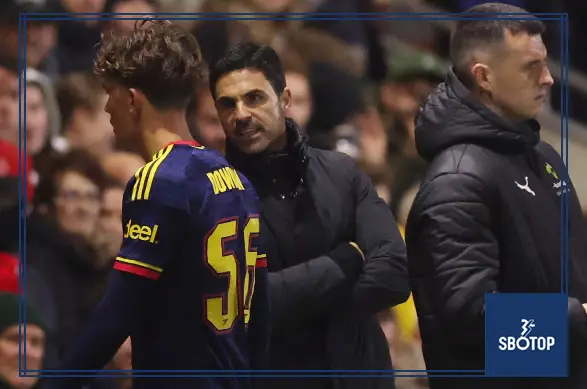
As Dowman headed towards the tunnel, Arteta addressed him in a visibly frustrated manner. The exchange prompted criticism from those who felt the manager should have offered immediate reassurance to a player still at an early stage of his development.
Former Arsenal midfielder Paul Merson was among those questioning the response. His objection concerned the treatment of the teenager after the incident, rather than a claim that first-team players should face no consequences for losing their composure.
Arteta later defended his approach by referring to his relationship with Dowman and conversations that had taken place before the match. He also said that a subsequent discussion between them had left no issues outstanding.
The precise words spoken beside the pitch should not be invented. The visible exchange showed frustration, but it did not reveal every detail of their relationship or the full substance of their private discussions. Any assessment needs to recognise that limit.
Challenging the Decision While Demanding Better
Arsenal’s unsuccessful appeal demonstrated that the club disputed the dismissal. Arteta expressed disappointment with the outcome and argued that the challenge preceding Dowman’s reaction needed greater consideration.
At the same time, he maintained that the player had to manage his response more effectively. Those positions are not inherently contradictory. A club can question the severity of a disciplinary decision while still expecting a player to avoid retaliation.
The distinction matters because two separate issues were involved: whether the official decision was justified and how Dowman should respond to difficult treatment in future. The appeal addressed the first. Arteta’s coaching message addressed the second.
The manager’s criticism of the original challenge should also remain attributed to him. It was his assessment of the incident, rather than an independent medical finding or proof of an injury that had occurred. Strong objections do not remove the need for accurate descriptions.
Why Emotional Control Matters to the Team
Arteta’s central concern was the collective consequence of an individual reaction. Once a player is dismissed, teammates must cover additional space, adjust their responsibilities and pursue the result with fewer options.
That effect explains why managers often treat retaliation differently from an ordinary technical error. A misplaced pass may be followed immediately by a recovery run. A red card prevents the player from repairing the situation on the pitch.
For an attacker who attracts challenges, emotional control therefore becomes part of competitive effectiveness. Remaining available allows the player to keep influencing the game, draw fouls and contribute to attacks rather than leaving teammates to compensate.
This does not mean accepting dangerous play without complaint. Players can seek the referee’s attention, communicate through their captain and rely on the club to raise concerns afterwards. The practical objective is to challenge unfair treatment without creating a further disadvantage.
Dowman’s Age Makes the Coaching Task More Complex
Dowman’s age is central to the discussion. A 16-year-old entering senior football is learning to manage pressures that extend beyond technical ability: physical challenges, public scrutiny, tactical demands and the consequences of mistakes.
Acknowledging those demands does not require assuming that he cannot cope with criticism. Equally, first-team involvement does not make his developmental needs identical to those of an experienced professional.
The coaching task is to communicate clearly without allowing correction to become a lasting public label. A young player needs to understand what went wrong, how to respond differently and whether the club’s confidence remains intact.
Arteta’s public explanation attempted to hold those elements together. He described the need for honesty and demanding standards while maintaining that Dowman was supported. Whether that balance works is better assessed through continued guidance and opportunities than through one isolated touchline exchange.
A Previous Dismissal Informs Arteta’s Concern
Arteta also referred to Dowman having been sent off while representing England’s under-19s earlier in October. He presented the recurrence as a reason to address emotional reactions promptly rather than wait for another costly incident.
The earlier dismissal gave context to the manager’s concern, but it should not become a basis for predicting the teenager’s entire career. Two incidents identify something to work on; they do not establish an unchangeable personality.
Similarly, the fact that Arteta had discussed potential challenges before the Fleetwood match does not mean every subsequent decision was simple. Players react in real time, often after physical contact and under competitive pressure.
That difficulty explains the need for preparation rather than removing accountability. The useful next step is practical learning: recognising situations that trigger frustration and developing responses that preserve concentration, discipline and the ability to remain involved in the match.
Suspension Creates an Immediate Sporting Cost
The upheld dismissal carried a three-match domestic ban. The affected league fixtures were Arsenal’s trip to Liverpool, the home match against Hull City and the visit to Newcastle United on 21 November.
The punishment therefore extended beyond the competition in which the red card occurred. Dowman’s absence reduced Arteta’s selection options across a sequence of Premier League matches.
That is one reason the manager focused on consequences rather than treating the incident as finished when the final whistle sounded. A reaction lasting only seconds can affect availability for several weeks, depending on the fixture schedule.
For Dowman, suspension also means missed opportunities to gain senior experience. Training can continue to support development, but it cannot fully reproduce the decisions and pressure of competitive minutes. The sporting cost gives the lesson substance without requiring additional speculation about internal punishment.
Accountability Must Be Consistent and Proportionate
Arteta argued that Dowman should face the same expectations as other first-team players. Consistency is important because teammates need to believe that selection and discipline operate through understandable standards.
However, consistent expectations do not require identical communication with every individual. Managers routinely adapt their explanations to a player’s experience, personality and circumstances while maintaining the same underlying requirement.
In this case, the requirement was clear: avoid a reaction that risks dismissal and disadvantages the team. How best to reinforce that message remains a coaching judgement, and reasonable observers can disagree about the public response.
What should be avoided is turning that disagreement into unsupported claims about either participant. There is no need to invent a broken relationship, hidden confrontation or loss of trust when Arteta publicly described their subsequent conversation as problem-free.
The Next Response Will Matter More Than the Headline
The lasting significance of the incident will depend on what Dowman does when faced with a similar challenge. A different response would demonstrate learning more clearly than any statement about determination or maturity.
Arsenal’s responsibility is to help make that improvement possible. Clear instruction, continued support and fair opportunities can turn a costly mistake into useful experience without pretending that the consequences were insignificant.
Arteta’s Disneyland remark captured the uncompromising side of his message, but the complete issue was more nuanced. Dowman needs protection as a young player and preparation for senior football’s demands. Those needs can coexist.
For now, the confirmed facts remain straightforward: a late dismissal, an unsuccessful appeal and a three-match suspension. Beyond them lies a coaching challenge that cannot be resolved by a single phrase. The meaningful answer will emerge through Dowman’s decisions on the pitch and Arsenal’s handling of his development.
Also Read: