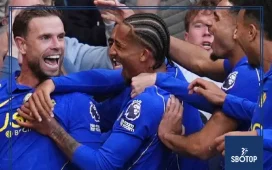
Daniel Bennie scored the decisive goal as Dundee United defeated Hibernian 1-0 at Tannadice, handing Marink Reedijk a losing start to his managerial reign.
The winger, on loan from Queens Park Rangers, struck in the 35th minute of Saturday’s Scottish Premiership contest. His close-range finish secured United’s first home league victory of the season and lifted them to fifth at the conclusion of the match, while Hibs remained tenth.
The visitors’ afternoon became more difficult when substitute Jacob Devaney was dismissed late on following a video review. However, they still threatened an equaliser in added time, forcing Jack Walton into an important save from Martin Boyle.
For United, the result rewarded a performance containing creativity, persistence and defensive resolve. For Reedijk, it provided an immediate illustration of the improvements required as he begins work with his new squad.
Continuity Meets a Fresh Beginning
The teams approached the fixture from contrasting positions. Jim Goodwin retained the Dundee United starting side that had beaten St Mirren before the international break, placing his trust in continuity after an encouraging result.
Reedijk, meanwhile, was overseeing his first competitive match as Hibernian manager. He had spent the preceding fortnight working with his players, introducing ideas and assessing a squad seeking improvement.
Hibs made three changes from their previous league outing against Kilmarnock. Marko Ivezic came in for his debut, while Ante Suto and Thibault Klidje also entered the starting line-up.
A managerial appointment can create optimism, but its practical effects require time. New instructions must become habits under pressure, particularly when players face opponents already comfortable within an established approach. This contest offered an early test of that adjustment rather than a definitive verdict on Reedijk’s prospects.
Hibs Show Early Intent
Hibernian produced the first notable opening when Felix Passlack found Josh Mulligan, whose effort was blocked. It was a promising moment for the visitors, demonstrating their ability to connect passes and reach a shooting position.
United initially had to negotiate a fragmented opening rather than immediately impose themselves. That required patience: forcing ambitious passes too early could have offered Hibs opportunities to attack an unsettled defence.
The home side gradually found a more productive rhythm. Their attacking movements began to stretch the visiting back line, and the connection between Lyall Cameron and Jesse Randall became increasingly influential.
The opening stages therefore contained encouragement for both teams. Hibs showed purpose, but United developed the more sustained threat. As the half progressed, the hosts turned isolated attacking moments into repeated pressure.
Cameron Gives United Direction
Cameron played an important role in moving United’s attacks forward. His passing repeatedly located Randall in dangerous positions, giving the winger opportunities to test Raphael Sallinger.
One early opening brought a save from the Hibs goalkeeper before the same combination produced another threatening attempt. Those sequences helped establish an attacking pattern: Cameron identified space, and Randall supplied the movement to exploit it.
The value of that relationship extended beyond the shots themselves. When defenders must repeatedly adjust to runners receiving behind or beside them, maintaining a compact shape becomes more difficult.
Cameron later supplied the delivery for the winning goal, completing a first half in which his influence was central. Goodwin subsequently praised the midfielder’s performance and suitability to United’s style, reflecting the importance of using players in roles that encourage their strongest qualities.
Bennie Keeps Searching for His Moment
Bennie’s winner followed earlier opportunities that he had failed to convert. Rather than withdrawing from the contest after missing, he continued to make himself available near goal.
That persistence mattered. Attacking players rarely receive identical chances, and frustration after one unsuccessful attempt can affect the movement or concentration needed for the next.
United eventually created the decisive opening by keeping an attack alive. Hibernian only partially cleared a delivery, Cameron lifted the ball back towards the six-yard area, and Bennie bundled it home.
The finish rewarded his positioning more than elaborate technique. He was close enough to goal to turn the recycled delivery into a decisive touch.
For United, the move also demonstrated the importance of second phases. An initial clearance does not end an attack if supporting players react quickly and maintain pressure around the penalty area.
United Continue to Seek a Second Goal
United’s approach after the interval suggested they recognised the limitations of a one-goal advantage. They continued creating openings rather than immediately retreating into protection mode.
Bennie remained involved, combining with Kevin Ciubotaru on the left and arriving to meet a low delivery, although he could not direct the opportunity on target.
Further attacks involved Randall, whose movement again brought Sallinger into action. Zidane Iqbal also contributed a pass that helped open space down the right.
These moments illustrated the range of United’s attacking options. Their threat was not confined to one player or one side of the pitch.
Nevertheless, the missing second goal remained significant. Every unsuccessful attempt left Hibs within reach, increasing the importance of concentration whenever possession changed hands. United had established the better platform without making the result secure.
Sallinger Keeps Hibernian Competitive
Sallinger’s contribution prevented United from building a more comfortable lead. His saves against Randall were particularly important in a match where the home side repeatedly found promising shooting positions.
For a goalkeeper, such an afternoon requires more than responding to individual attempts. Positioning, readiness and the ability to recover after an initial intervention all influence whether pressure becomes a goal.
Hibs benefited from having their goalkeeper keep the deficit manageable. Even when their attacking play lacked sufficient consistency, the possibility of recovering a point remained alive.
That should not obscure the problems in front of him. Repeatedly allowing opponents to enter dangerous areas places an unsustainable burden on a goalkeeper. Reedijk will need to examine how Hibs can restrict those openings while preserving enough attacking ambition to threaten at the other end.
Reedijk Looks for an Attacking Response
Reedijk introduced Boyle, Nathan Lowe and Rabbi Matondo during the second half as he searched for a way back into the contest.
Matondo offered an immediate reminder of Hibernian’s counterattacking potential, breaking forward before Bert Esselink intervened with an important block. The incident showed why United could not treat their territorial advantage as complete control.
Substitutions can alter a match by changing its speed, physical demands or attacking reference points. However, fresh personnel still need coordinated support and a clear route towards goal.
For Hibs, the challenge was to produce threatening actions more frequently rather than rely on occasional breaks. Their late opportunity demonstrated that an equaliser remained possible, but possibility alone could not compensate for the sustained pressure United had generated.
Video Review Changes the Late Drama
The match’s most consequential late incident involved Devaney and United substitute Neil Farrugia. Farrugia broke beyond the visiting defence and was brought down, prompting referee Don Robertson initially to award a penalty and show Devaney a yellow card.
Following a review at the monitor, the offence was judged to have occurred outside the penalty area. Robertson changed the restart to a free-kick and dismissed Devaney.
The final outcome therefore differed substantially from the initial decision: United did not receive a penalty, while Hibs had to finish with ten players.
Abdoulaye Yoro tested Sallinger from the resulting set-piece, but the score remained unchanged. The incident increased the difficulty of Hibernian’s recovery attempt without ending it, leaving United responsible for seeing out the remaining minutes.
Walton Protects the Points
Despite their numerical disadvantage, Hibs continued searching for an equaliser. Their persistence produced a late opportunity for Boyle, whose effort required Walton to make a strong low save.
It was a decisive contribution in a different phase of the match from Bennie’s goal. One player established the advantage; another protected it when the visitors threatened to remove it.
United’s clean sheet depended on collective defending as well as their goalkeeper. Esselink’s earlier intervention and the team’s resistance during the closing pressure also helped preserve the result.
Still, Walton’s late action underlined the narrow margin. A match featuring several promising home attacks could have ended level without that save. United deserved credit for their performance, but they also needed precision at the final defensive moment.
Also Read: