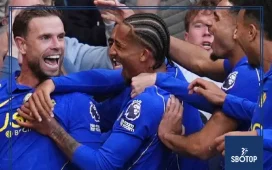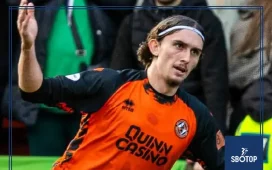
Ashley Hay marked his return from injury with a stoppage-time winner as Dundee overturned a half-time deficit to defeat Falkirk 2-1 at Falkirk Stadium on Saturday, October 10.
Jacob Murrell’s first-half penalty had put the hosts ahead, but Owen Bevan equalised seven minutes after the interval. Dundee continued searching for another goal and eventually found it when Hay reacted quickest to Ethan Hamilton’s free-kick in the first minute of added time.
Even then, the drama was unfinished. Falkirk launched a desperate response, and Dundee goalkeeper Owen Goodman needed to intervene during a crowded goalmouth scramble to preserve the victory.
For Steven Pressley’s side, the result combined attacking persistence with resilience under difficult circumstances. For Falkirk, another costly late concession turned a potentially useful point into a painful home defeat.
Dundee Begin With Attacking Purpose
Dundee’s approach was positive from the opening exchanges. They moved forward quickly, delivered into dangerous areas and forced Falkirk to defend before the home side could establish a comfortable rhythm. Bradley Fink threatened inside the opening minute, setting the tone for an afternoon in which Dundee repeatedly tested the home defence. Rather than waiting to assess Falkirk’s intentions, the visitors immediately attempted to impose their own.
That ambition was significant given their selection problems. Injuries had reduced Pressley’s options, but his available players still approached the contest with confidence.
A depleted team can sometimes become cautious, concentrating primarily on limiting mistakes. Dundee instead sought to create problems through movement, deliveries and repeated attempts on goal. Their early pressure did not immediately produce a breakthrough, but it established an attacking threat they maintained throughout the match.
Wright Almost Produces an Extraordinary Opener
One of the first half’s most memorable moments came when Drey Wright spotted Scott Bain away from his goal and attempted an audacious effort from distance.
The quickly taken free-kick forced the Falkirk goalkeeper to retreat sharply and tip the ball over the crossbar. It was an unusual opening created through awareness rather than a conventional attacking move.
Such attempts carry an obvious risk of surrendering possession, but Wright’s execution required a genuine save. His decision reflected a Dundee side alert to opportunities wherever they appeared.
Bain’s intervention also illustrated his importance to Falkirk. Before the hosts had taken the lead, he had already contributed to keeping the match level. Dundee were finding ways to threaten, although they still lacked the decisive finish needed to turn their promising start into an advantage.
Murrell Gives Falkirk the Lead
Despite Dundee’s attacking pressure, Falkirk scored first in the 31st minute.
Finley Barbrook moved in front of Callum Jones inside the penalty area and was caught as the Dundee midfielder attempted to clear. The resulting penalty gave the home side an opportunity to change the direction of the contest.
Murrell converted, putting Falkirk ahead and forcing Dundee to confront a frustrating situation: they had created danger but were trailing.
For Falkirk, the goal offered something tangible around which to build. They could now attempt to manage possession, protect their defensive shape and exploit spaces if Dundee committed additional players forward.
The hosts also threatened before the interval when Bain’s long delivery released Leon McCann. However, the full-back could not convert the opening, leaving Falkirk with a narrow advantage rather than a more substantial cushion.
Dundee Refuse to Let Frustration Take Over
Trailing at half-time presented Dundee with a test of judgement as well as determination. They needed greater accuracy without abandoning the attacking approach that had already created opportunities.
A team can respond badly to an apparently undeserved deficit by rushing passes or attempting speculative shots. Dundee’s challenge was to remain purposeful while recognising that the score required a response.
Their eventual recovery suggests they maintained sufficient belief in their approach. They continued delivering into the penalty area and competing for the next phase when an initial attack failed.
That does not mean every decision was effective. Several opportunities still ended without the necessary finish. However, Dundee avoided allowing disappointment to become passivity. They kept making Falkirk defend, ensuring that the home side’s lead remained under examination after the restart.
Owen Bevan Restores Parity
The equaliser arrived in the 52nd minute following a corner that Dundee successfully kept alive.
Joe Bevan prevented the ball from running out beyond the far post, and the visitors worked possession back towards Wright. His delivery found Owen Bevan, who headed home from close range.
The move demonstrated the importance of reacting after the first clearance or delivery. Falkirk had not completed the defensive task simply because the original corner had travelled beyond its immediate target.
For Dundee, persistence created another opportunity to place an accurate ball into the danger area. Bevan supplied the decisive movement and finish.
The goal also changed the match’s balance. Falkirk could no longer organise their decisions around protecting a lead, while Dundee had time to pursue a full turnaround rather than concentrate solely on rescuing a point.
Fink’s Disallowed Finish Prolongs the Uncertainty
Dundee thought they had taken the lead when Fink ran onto Joe Bevan’s pass and finished past Bain. The celebrations were cut short by an offside flag, with the decision subsequently confirmed through video review.
The disallowed goal preserved the level score and reminded the visitors that promising attacking play still required precise timing.
For forwards, the distinction between a well-timed run and an offside position can be extremely narrow. The incident offered evidence of Dundee’s ability to penetrate without providing any reward on the scoreboard.
Falkirk remained dangerous enough to require attention at the other end. Goodman was called upon as the home side sought their own route back in front.
With neither team able to establish a decisive advantage, the contest moved towards a closing phase in which one accurate delivery or defensive error could determine the outcome.
An Injury-Hit Side Keeps Going
The physical demands on Dundee gave their late persistence additional significance. Pressley made no substitutions, leaving the starting eleven to complete the match despite the squad’s injury problems.
Hay was playing for the first time since August 8 after a knee injury, and his manager revealed afterwards that he had initially been expected to manage approximately an hour.
Joe Bevan was also struggling physically, further complicating Dundee’s situation. Yet the visitors continued competing rather than fading after the interval.
It would be simplistic to attribute that entirely to mentality; fitness, positioning and efficient use of possession also influence a team’s capacity to sustain its performance.
Nevertheless, Dundee’s ability to remain threatening late in the match was an important achievement. Their winning goal came from players who had already carried a substantial workload and still reacted decisively.
Hay Finds the Decisive Touch
The winning moment arrived in the first minute of stoppage time when Hamilton sent a free-kick into Falkirk’s penalty area.
The home defence failed to resolve the danger, and Hay reacted to the loose ball at close range. After bringing it under control with his chest, he finished quickly past Bain.
It was a goal built on proximity, anticipation and speed of response. Hay remained involved in the immediate contest rather than waiting for a perfectly presented opportunity.
For a player returning from an extended absence, the moment carried particular significance. His contribution transformed a draw into an away victory and rewarded Dundee’s continued willingness to attack.
One goal cannot establish how his season will unfold, but this return provided an immediate and valuable contribution when his team needed another attacking option.
Goodman Ensures the Winner Stands
Falkirk responded urgently after falling behind, pushing forward in search of a last opportunity to recover a point.
Their pressure produced a frantic scramble, with Goodman turning Craig Sibbald’s effort onto the crossbar. The intervention prevented Dundee’s celebrations from being followed by an immediate reversal of fortune.
Late winners still require protection. The scoring team must reset quickly, organise itself and defend against opponents whose approach has become increasingly direct.
Dundee were tested in precisely that way. Their goalkeeper’s contribution was therefore as important to the final outcome as the attacking action that had established the lead.
The narrow finish also showed that Falkirk retained the capacity to threaten. Their frustration lay in producing that urgency only after the match had swung against them.
Contrasting Lessons From a Dramatic Finish
Dundee’s victory offered Pressley evidence that his available players could compete effectively despite significant selection difficulties. They recovered from conceding first, maintained an attacking threat and found a decisive moment late on.
For Falkirk manager John McGlynn, the concerns were more familiar. This was another occasion on which a late concession cost his side points, following recent draws against Dundee United and St Johnstone.
The practical response must involve better management of the closing stages: avoiding unnecessary fouls, defending deliveries decisively and reacting to loose balls.
It would be premature to draw sweeping conclusions about either club’s season from one afternoon. What the match established was clear enough. Dundee sustained their pursuit of victory, Hay supplied the decisive finish, and Falkirk were left examining another result that escaped them at the end.
Also Read: