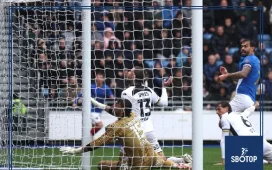


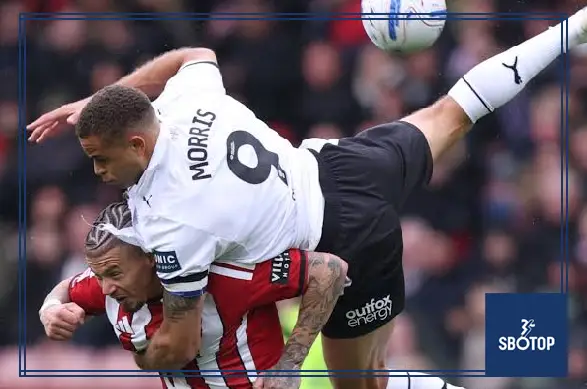
Patrick Bamford rescued a point for Sheffield United against ten-man Derby County, but his equaliser came at a personal cost as he was injured while scoring in a 1-1 Championship draw at Bramall Lane.
Bobby Clark had given Derby a first-half advantage before Dion Sanderson’s dismissal changed the balance of Saturday’s contest. Bamford eventually converted at the far post in the 79th minute, although the hosts could not complete the turnaround despite sustained late pressure.
Jacob Widell Zetterström made several important saves to preserve Derby’s point. For Sheffield United, the result brought frustration after an opportunity to capitalise on their numerical advantage. For the visitors, it represented determined resistance, tempered by the disappointment of surrendering a lead.
Derby Establish an Attacking Presence
The opening stages did not immediately suggest that Derby would spend the closing period defending desperately. They sought opportunities to attack behind Sheffield United’s defence and created situations that required intervention from the hosts.
Henrik Meister threatened after receiving a pass from Sammie Szmodics, with Hamza Choudhury blocking his low effort. At the other end, Ben Brereton Díaz tested Zetterström after meeting a Tahith Chong delivery.
Those exchanges gave the match an initially competitive shape. Neither side could assume control simply through territory or possession.
From an analytical perspective, Derby’s willingness to threaten mattered. An away team needs enough attacking presence to prevent its opponents advancing without concern. Their early opportunities established that Sheffield United would have defensive work to complete alongside their search for a breakthrough.
Clark Provides a Persistent Threat
Clark became an increasingly important figure as Derby developed their attacking play. Before scoring, he had already required Sheffield United to defend attempts around the penalty area.
His involvement illustrated the value of support arriving behind the forwards. A striker holding the ball or occupying defenders can create an opportunity for a midfielder to attack the next space.
The hosts also threatened through Kalvin Phillips, whose long-range effort forced Zetterström into action. Nevertheless, it was Derby who found the opening goal.
For Sheffield United, that sequence exposed the danger of allowing an opponent repeated opportunities to settle around the box. Individual blocks and saves can prevent an immediate concession, but sustained protection requires reducing the number of dangerous situations that develop.
A Rebound Gives Derby the Lead
Derby went ahead in the 37th minute after Ryan Hedges struck the near post with a low effort. The rebound reached Clark, who finished from around the edge of the penalty area.
The goal rewarded his readiness to react. The initial shot had not gone in, but the attacking move remained alive, and Clark recognised the opportunity before the defence could fully recover.
For Sheffield United, the incident changed the immediate task. They now needed an equaliser rather than simply an opening goal, while Derby gained an advantage to protect.
A lead of one goal, however, provides limited security. Derby still required a way to maintain possession, relieve pressure and continue threatening. The remainder of the afternoon would place increasingly severe demands on those objectives.
Sheffield United Seek a Stronger Response
Chris Wilder changed his side shortly before the hour, introducing Sydie Peck and Femi Seriki. Further attacking changes followed, with Jordan Ayew and Romelle Donovan entering the contest.
Substitutions can alter the character of a game, but their effectiveness depends on the roles involved. Fresh energy alone does not guarantee clearer chances.
A team chasing an equaliser needs players who can provide width, offer movement between defenders and support possession after the first delivery is cleared. It must also protect itself against the opponent’s attempts to break away.
Sheffield United’s changes increased the options available as they searched for a response. Donovan would eventually supply the decisive cross, but the turning point before that came through Derby losing a defender.
Sanderson’s Second Booking Changes the Contest
Sanderson was dismissed in the 66th minute after receiving a second yellow card for a challenge on Seriki while attempting to stop a Sheffield United counterattack.
Derby had to reorganise with ten players while still holding their one-goal lead. Their subsequent work involved defending the penalty area, blocking attempts and relying on Zetterström when the hosts found a route through.
The visitors’ official account highlighted the contribution of Ryan Nyambe and Carlton Morris in denying late opportunities, alongside their goalkeeper’s interventions.
The dismissal did not make an equaliser inevitable. It did, however, increase the strain on Derby’s remaining players and provide Sheffield United with greater scope to sustain pressure. Managing space became the visitors’ overriding concern.
Numerical Superiority Creates Opportunity
Playing against ten can appear straightforward from outside the pitch, but an attacking team still has to solve a concentrated defensive structure.
The extra player may improve passing options without necessarily creating space directly in front of goal. Defenders can remain compact and allow circulation in areas where possession poses less immediate danger.
Sheffield United therefore needed purposeful variation. Changing the point of attack, finding runs beyond the defensive line and recovering cleared balls could all help maintain pressure.
At the same time, urgency had to remain controlled. Repeated speculative attempts might have made Derby’s task easier by ending attacks prematurely. The hosts required a delivery and movement combination capable of taking advantage of the opportunities their pressure was generating.
Donovan Finds Bamford at the Far Post
The equaliser arrived when Donovan delivered across the penalty area and Bamford reached the far post to force the ball over the line from close range.
The goal was recorded in the 79th minute, with Donovan credited with the assist. Bamford was injured during the scoring action and was replaced by Tyrese Campbell in the 81st minute.
The immediate consequence was therefore mixed for Sheffield United. They had restored parity and gained time to pursue a winner, but lost the player who had supplied their breakthrough.
No confirmed diagnosis or recovery timetable was established in the match account. His departure showed that he could not continue that afternoon; any wider assessment of the injury required further information.
Bamford’s Movement Rewards the Delivery
The equaliser demonstrated the importance of far-post positioning. Defenders naturally respond to the ball and the closest attacking threat, but a runner on the opposite side can exploit a momentary gap.
Bamford’s task was to remain available and arrive where Donovan’s cross could be converted. The finish came from close range, yet creating that situation required coordination between provider and scorer.
Analytically, the goal also showed why wide delivery remains useful against compact opponents. It can shift the defensive problem from protecting central passing lanes to tracking movement across the goalmouth.
For Derby, the concession was a painful interruption to their resistance. For Sheffield United, it created a fresh challenge: turn the remaining pressure into another goal before the visitors could secure the draw.
Zetterström Protects Derby’s Point
The closing stages belonged increasingly to Sheffield United’s search for a winner and Derby’s attempts to prevent it. Zetterström became central to the outcome.
Campbell forced an excellent save, with the goalkeeper turning the effort onto the crossbar and away. Peck also tested him, while additional attempts failed to produce a second home goal.
Goalkeeping of that quality has an obvious influence, but it should be understood alongside the defenders’ work. Blocks, pressure on shooters and reactions to rebounds help determine the difficulty of each save.
Derby could not eliminate every opportunity. They nevertheless kept responding to the next threat, ensuring that one concession did not become the beginning of a complete collapse.
The Draw Leaves Different Frustrations
Sheffield United could point to their late pressure and the quality of Zetterström’s saves as reasons the match might have ended differently. However, the first half remained part of their assessment.
Their numerical advantage applied only after Sanderson’s dismissal. Before that, Derby had created danger and earned the lead. Evaluating the entire performance therefore required more than counting the chances in the closing stages.
Derby’s frustration was different. They had been ahead and could imagine a route to victory, but the dismissal made protecting all three points substantially harder.
A point rewarded their resilience without removing the broader need for wins. Their league record remained difficult, and resistance alone would not be enough to transform the season.
Bramall Lane Finish Provides No Winner
The 1-1 result captured a match that changed significantly after the break. Clark’s opener rewarded Derby’s first-half threat, while Sanderson’s dismissal gave Sheffield United a stronger platform to attack.
Bamford supplied the equaliser but could not remain on the field. His teammates continued searching, only to find Zetterström and Derby’s remaining defenders unwilling to concede again.
For the hosts, the lesson concerned producing a more complete performance rather than depending on a late surge. For Derby, it involved combining their determination with greater discipline and a more sustainable route to results.
Both teams had reasons to feel disappointed. Yet the decisive distinction was clear: Sheffield United found an equaliser, while ten-man Derby found enough resistance to prevent it becoming a winner.
Also Read: