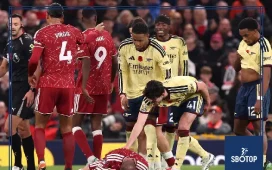



Arsenal’s 1-0 victory at Liverpool on Sunday, 1 November 2026, was decided by Kai Havertz’s first-half finish, but the reaction centred on how the visitors protected it. Declan Rice supplied the assist and contributed throughout a demanding performance that prompted Jamie Carragher to describe him as a world-class midfielder. Gary Neville praised Arsenal’s collective defending as a masterclass.
The result ended Arsenal’s fourteen-year wait for a league victory at Anfield and strengthened their position at the top of the table. Yet the significance lay as much in the method as the milestone. Mikel Arteta’s team found a breakthrough, absorbed pressure and retained enough attacking threat to prevent the contest becoming entirely one-sided.
Praise still requires context. Liverpool created opportunities and had a legitimate penalty grievance. Arsenal’s performance was highly effective, but recognising its quality does not require describing every defensive action as flawless or treating one victory as a guarantee of another championship.
Havertz Finishes the Move That Separates the Teams
The decisive goal arrived in the 16th minute after Arsenal recovered possession while Liverpool attempted to play out from a goal-kick. Rice advanced down the right and delivered a low cross for Havertz, who finished from close range at the far post.
The move connected Arsenal’s work without the ball to their attacking execution. Winning possession mattered because the players immediately used it to reach a dangerous area.
Rice’s contribution also illustrated why his influence cannot be understood solely through defensive actions. His forward movement created a passing route, and his delivery gave Havertz the opportunity to complete the attack.
From an analytical perspective, that connection is central to an effective team structure. Recovering the ball and creating a chance should not be treated as unrelated phases. Arsenal combined them in the sequence that ultimately supplied the winning goal.
Carragher Places Rice Among the Elite
Carragher’s assessment went beyond praising a strong individual match. He ranked Rice as the Premier League’s leading midfielder and placed him in the conversation with outstanding midfielders from Arsenal’s history. Those were evaluative judgments rather than an official ranking or an objectively settled comparison.
The distinction matters because terms such as world class depend on criteria. Some observers prioritise technical creativity, others defensive range, consistency, versatility or performance in demanding fixtures.
Rice’s display offered a relevant combination: a direct contribution to the winning goal alongside work that supported Arsenal’s defensive balance. Carragher’s enthusiasm reflected that breadth.
However, one performance cannot resolve every comparison between players with different responsibilities. The more useful question is what Rice provided in this particular match. At Anfield, his value extended across phases, helping Arsenal threaten Liverpool while remaining equipped to defend the advantage they had established.
Defensive Strength Begins Before the Back Line
A clean sheet is often associated most closely with centre-backs and the goalkeeper. In practice, the protection they receive from players ahead of them can be equally important.
This provides a useful way to interpret Rice’s contribution. A midfielder can influence an attack before it reaches the penalty area by closing a passing lane, delaying a runner or positioning himself to collect a loose ball.
Those actions are not always dramatic enough to become the defining replay. Their value often lies in preventing an opponent from reaching a more dangerous situation.
Analytically, Arsenal’s collective resistance depended on coordination rather than isolated effort. If one player moved towards the ball, others needed to recognise the space being vacated. Rice’s defensive work belonged within that wider relationship. Praising him does not require diminishing the teammates whose positioning made his interventions useful and sustainable.
Liverpool’s Pressure Tests Arsenal’s Organisation
Liverpool responded to falling behind and produced several threatening moments. Florian Wirtz struck the woodwork with a free-kick, while Alexis Mac Allister headed over from a promising position before the interval. The hosts continued looking for an equaliser rather than allowing Arsenal to manage the match without challenge.
These opportunities qualify the description of a defensive masterclass. Arsenal were difficult to beat, but Liverpool were not prevented from entering dangerous positions altogether.
Effective defending can include recovery actions and forcing opponents into imperfect finishes. It does not necessarily mean every attack is stopped at its origin.
At the same time, missed opportunities remain part of the explanation. A defending team deserves credit for the pressure it applies, while an attacking side remains responsible for the execution of its chances. The match’s outcome reflected both Arsenal’s resistance and Liverpool’s inability to convert the openings available.
Rice’s Positioning Supports the Players Around Him
Midfield positioning involves repeated choices rather than remaining in one fixed location. A player must judge when to approach an opponent, when to hold his ground and when to support a teammate who has been drawn out.
In assessing Rice, this offers a more informative framework than counting only tackles or touches. An intervention may be useful because it restores the team’s shape, not simply because it wins possession immediately.
Equally, moving forward to assist an attack creates responsibilities for others. Arsenal’s balance required players to recognise those changes and adjust.
That is why individual excellence and collective organisation are closely connected. Rice could influence different areas because the team maintained relationships around him. His assist and defensive contribution were visible outcomes of that interaction, rather than evidence that one midfielder independently controlled every aspect of the contest.
Arsenal Preserve an Attacking Outlet
Arsenal did not rely exclusively on protecting their own penalty area. Liverpool needed important defensive interventions and an Alisson save from Christos Tzolis to keep their deficit at one goal during the second half.
Maintaining that threat matters when defending a narrow lead. An opponent that faces no consequence for committing players forward can sustain increasingly aggressive pressure.
An outlet gives the defending team opportunities to gain territory, retain possession and make the opposition reorganise. Even when it does not produce another goal, it can change the conditions under which the lead is protected.
This does not mean every counterattack should be pursued recklessly. The decision depends on support, space and the danger of losing the ball again. Arsenal’s task was to remain selective: threaten when the opportunity justified it and preserve the structure that had kept Liverpool from equalising.
The Penalty Incident Limits Claims of Perfection
The performance also included a significant officiating controversy. Jurrien Timber pulled Alexander Isak’s shirt as the Liverpool forward attempted to reach a cross, but no penalty was awarded. A subsequent review panel voted four to one that a penalty should have been given, with a three-to-two majority finding that VAR should have intervened.
That finding belongs in any balanced assessment of Arsenal’s defending. It identifies an action that the panel believed should have carried a substantial consequence.
However, the missed award does not establish what the final result would have been. A penalty still requires conversion, and its award would have changed the subsequent sequence.
Two conclusions can therefore stand together: Arsenal defended effectively across much of the match, and they benefited from a missed decision. Acknowledging the latter makes the analysis more accurate without erasing the quality of their wider performance.
Historic Comparisons Remain Matters of Judgment
Carragher’s praise extended to comparisons with celebrated Arsenal defensive units, including those associated with the club’s earlier title-winning teams. His assessment reflected admiration for their organisation under sustained pressure.
Such comparisons can illuminate a performance, but they need limits. Teams from different periods face different tactical demands, opponents and competitive conditions.
Longevity also matters. A defensive unit establishes its historical standing through repeated performances across seasons, not through one afternoon, however impressive.
The strongest conclusion from Anfield is therefore specific: Arsenal demonstrated the capacity to protect an early lead at a difficult away ground. Whether that performance belongs alongside the club’s greatest defensive achievements is an opinion informed by broader evidence. It is a meaningful discussion, but not a fact settled by the final whistle.
A Major Result Without a Guaranteed Destination
The victory moved Arsenal three points clear of Manchester City and nine ahead of Liverpool immediately after the fixture. It was also their fourth consecutive league win. Those details describe the position at that stage of the season rather than the current standings.
The result strengthened Arsenal’s campaign, but it did not settle the title race. Subsequent matches would require different solutions, including occasions when an early goal did not arrive or opponents presented another attacking approach.
Rice’s performance nevertheless provided strong evidence for the praise he received. He helped create the decisive moment and contributed to the work needed to preserve it. Havertz supplied the finish, while teammates maintained the organisation around them.
Anfield offered a clear demonstration of Arsenal’s competitive strengths: coordinated pressure, purposeful attacking execution and sustained defensive concentration. The flaws and fortunate decision remained part of the story. So did a midfielder whose influence helped connect the whole performance into a valuable victory.
Also Read: